Sketchbook Journey is my attempt at answering one question: How do people actually get so insanely good at drawing/illustrations? I don’t know the answer yet, but each entry in this series, I try and get just a little closer to finding an answer, by learning how to draw, myself.
I started drawing at age 24, work a full-time job at a factory, and live in Denmark. No kids, no partner, but I have a cat. Average daily drawing time is roughly 30 minutes. Usually stream on Discord every Sunday around 19:00–23:59 (CEST), drawing digital illustrations. Come say hi!
New entries, roughly every 60 days
Table of contents:
- How this journey started
- Point of Sketchbook Journey
- My Materials
- My current approach to learning
- Part. 1 – The journey begins!
- Part. 2 – Anatomy and Christmas
- Part. 3 – Half-way and death
- Part. 4 – Calls for a new plan
- Part. 5 – Comparisons
- Closing remarks
- Thoughts that occurred while writing
Video recap (1. year)
Video recap (2. year)
How this journey started
I've always been fascinated by – and looked up to people who can draw. Even as a kid, I would imitate their drawings, make things for them in the hopes that they'd teach me about their craft. However, my family had other plans for me, convincing me I had to become a full time, touring musician.
Time-skip into my early 20s, and I tell my parents I'm going to university, and quitting music all-together. I can't quite describe it, but their eyes fogged up with dissapointment, whereafter I started having to explain and justify all my decisions and all my efforts; only to be met with "If you become a priest, then I have failed as a mom" (I was studying to become a priest).
That comment broke my relation to them, and going forwards, I started searching for things that they did not know about –> hereunder, a new hobby that's easy to hide. Around the same time this happened, PewDiePie uploaded a video titled Teaching myself to draw for no reason. Getting to see someone I used to watch all the time, take up drawing and showcase that it is a learned skill – NOT a talent, inspired me to go do the same. So, on the 9th of December 2023, I started drawing, age 24.
Point of Sketchbook Journey
I've always wondered how people who are extremely good at a specific craft, manage to get there, partially because there does not exist any coherent books or resources on the matter, where I am able to follow rumage through their daily thoughts. Which is exactly why I keep working on Sketchbook Journey.
With Sketchbook Journey I'd like to share my semi-daily thoughts, as both my thoughts, and myself as a person, change thanks to drawing/art. I have no coherent 'ultimate goal' with this series, beyond – in the future – if I am asked "How'd you get this good?", I can point towards Sketchbook Journey as a record/archive of thoughts and feelings that led me to where I am today.
Aaaaand it gives me an excuse to yap on the internet :'D
NOTICE! The following sections change in accordance with me learning new stuff
Art materials
These are my main art materials. Please note that most of them are more luxury than necessity.
Sketchbooks:
A5 spiral-sketchbook (Primary sketchbook)
Pencils / Markers:
Flying-tiger Copenhagen HB-pencils
0.5 Graphgear500, Pentel (for writing)
Digital gear / programs:
none
Additional stuff:
Office/school pencil sharpener (Same one I've had since middle-school)
My mindset towards learning has been, that when I see my drawings and recognize they're not up to par, I don't shy away from admitting, 'This drawing genuinely isn't good.' However, simply labeling it as 'bad art' would just make me feel disheartened. Yet, it's equally unproductive to ignore the truth or make external excuses like 'I had a bad day.' No room for excuses here! Instead, I confront the reality by pinpointing specific areas I find lacking, or I ask others what errors they notice in my art. After every thought of 'This looks good' or 'This looks bad,' I immediately follow up with a 'why is that?' question. If I find the proportions seem off, I ask: 'Why are my proportions off?', and then point to what mistakes I see. From those mistakes, I know what I should study..
I find it easier to tackle something when I have a clear goal to aim for, as it helps me prioritize my study areas. I've made a commitment to dedicate 30 minutes each day to drawing, incorporating it into my daily routine. The goal is to make drawing as habitual as brushing teeth or having breakfast. What matters most to me at this stage isn't the quality of my drawings; even a few quick lines suffice. What truly counts is that I devote a solid 30 minutes every single day to drawing. To keep track of time, use this Pomodoro – 30 Minute Study Timer, as my guide every day.
For the next 60 days (starting December, 9th. 2023), I've set myself a goal: by day 60, I aim to recreate this stunning artwork by @rezxjv on Twitter. It features Ikuyo Kita, Hitori Gotoh, Nijika Ijichi (my personal favorite!), and Ryo Yamada.:
Part. 1 – The Journey Begins! – I have no sense of direction, I just draw what I want to for fun
Day 1
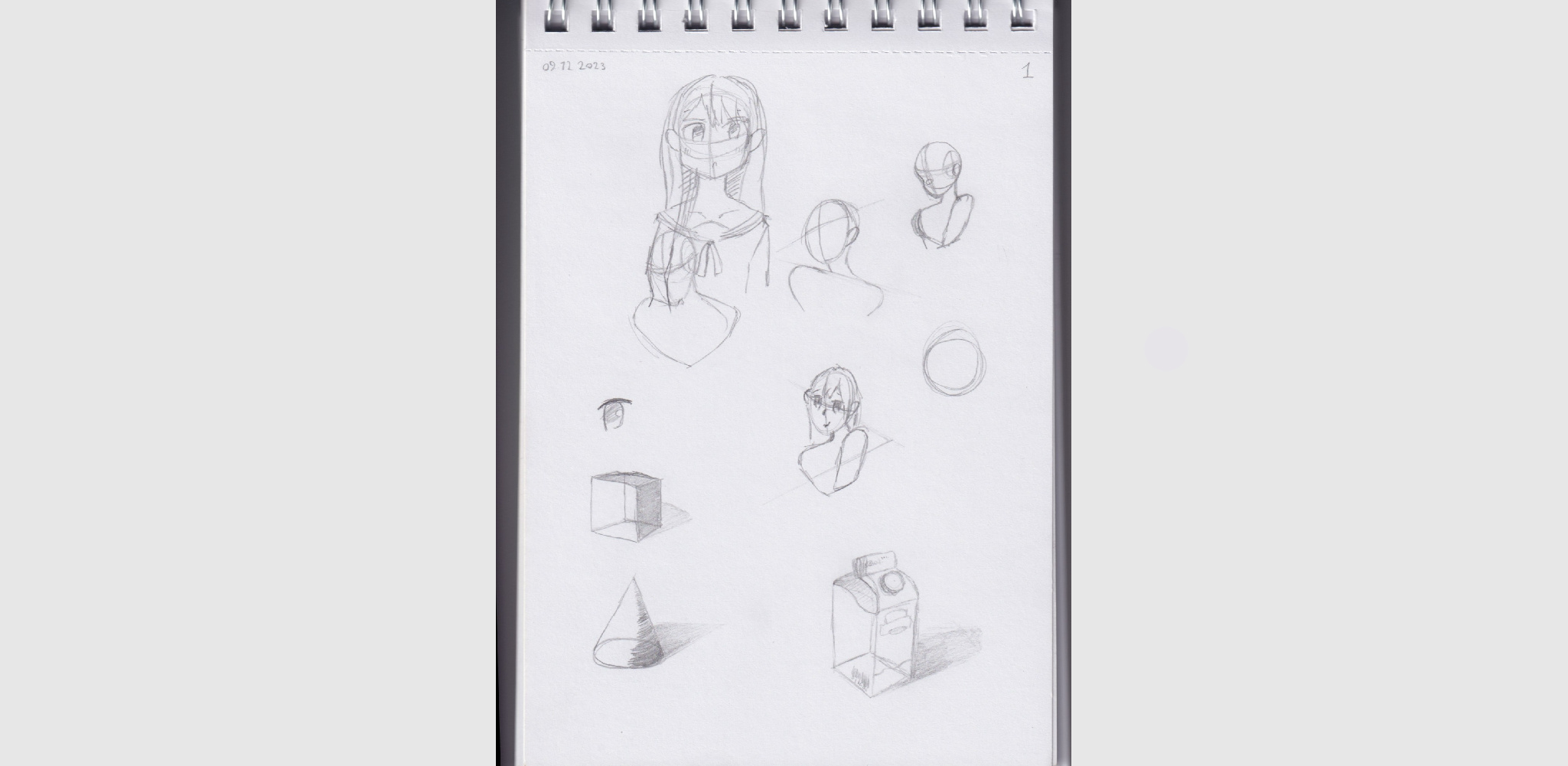
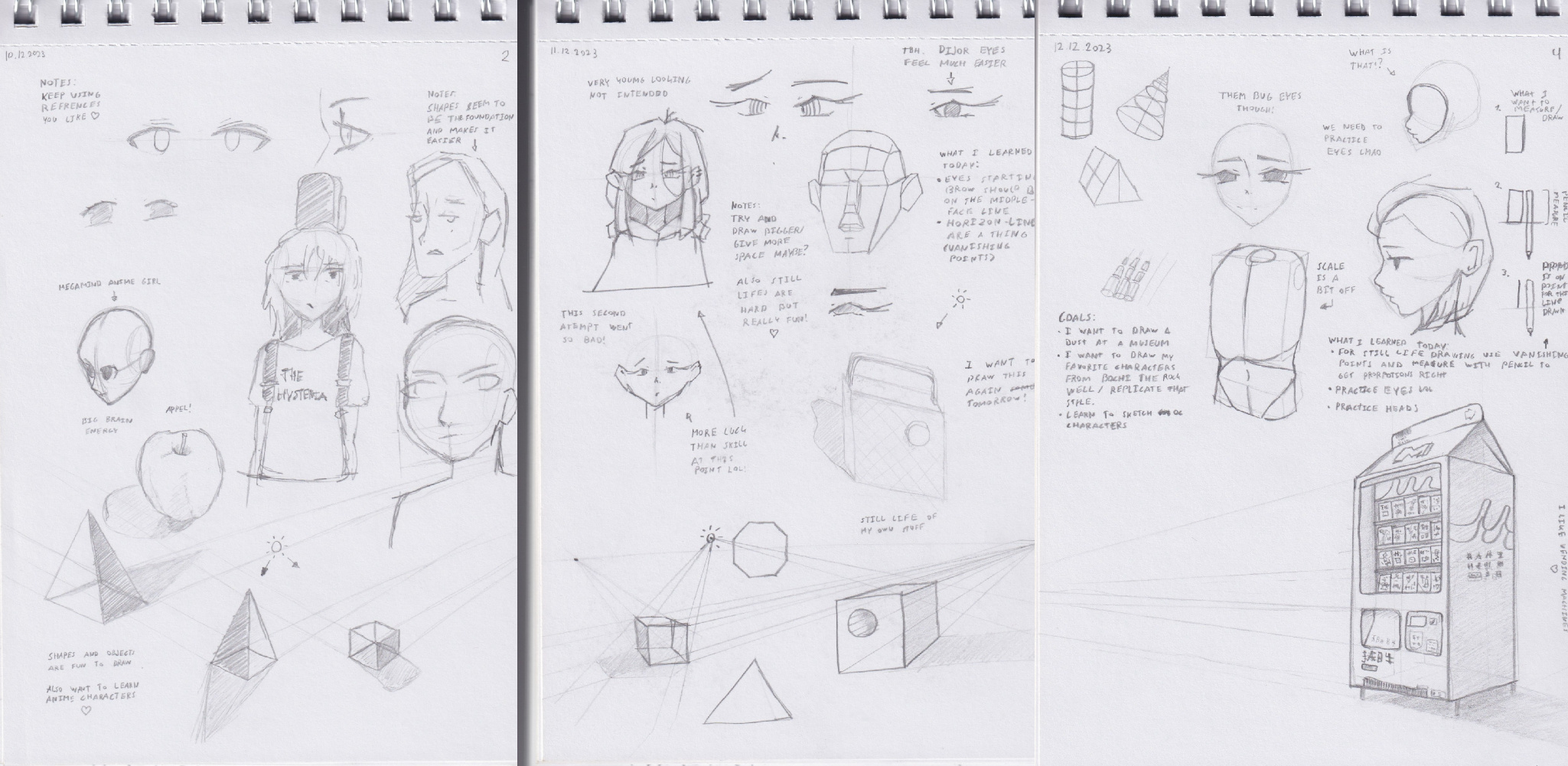
I started with random sketches, having a sense of excitement, as this is the first time I had ever bought art supplies, intending to learn and practice drawing with it. It was all about enjoying the moment, and finally feeling the excitement, of having- and following a dream.
Day 2-4
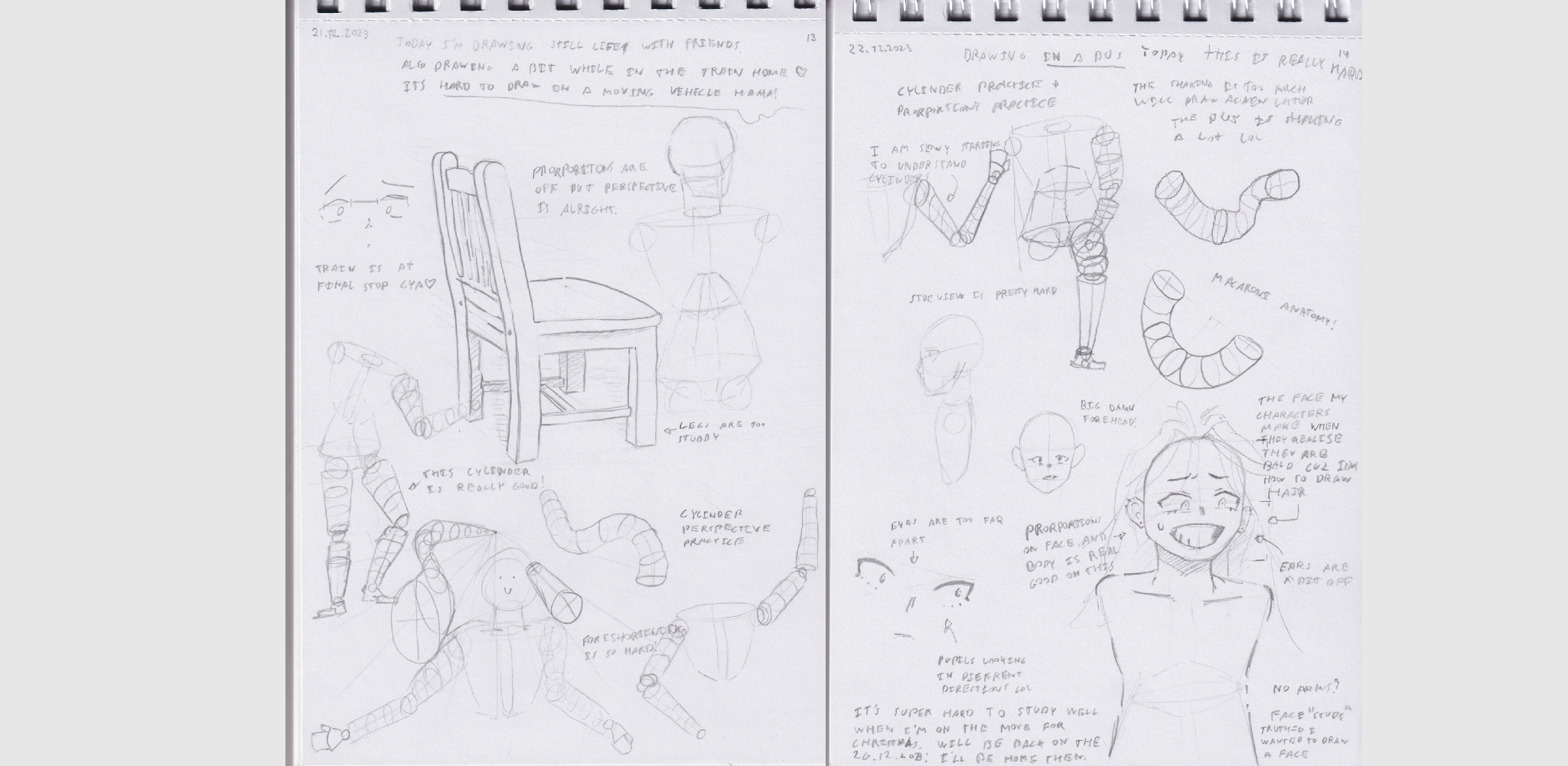
I spent most of the time having fun and learning about still-life drawings. I have later come to learn, that still-lifes are great for grasping perspectives and proportions with the use of vanishing points, in order to make my drawings look more 3-dimensional. I also started taking notes in my sketchbook, writing my thoughts as I was drawing.
Day 5-6
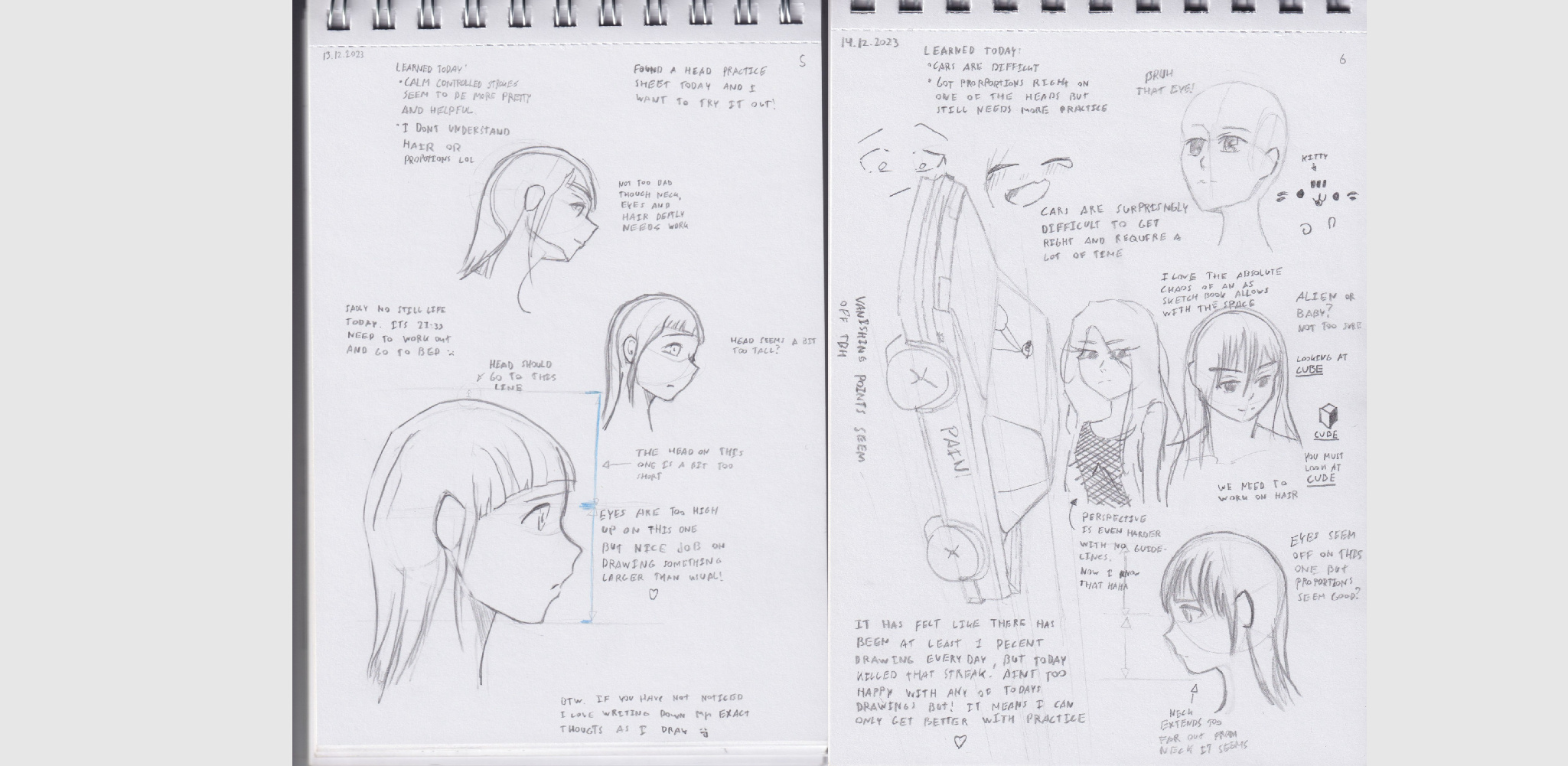
I began to think of giving my drawing a specific direction. One thing I have always wanted to be able to draw is portraits of characters, so I decided to try and study drawing the head and face from different angles. On day 6 I also tried drawing a still-life of a car (it did not go well).
Part. 2 – Anatomy and Christmas – Learning basic-shape-anatomy and learning to deal with time
Day 7-9
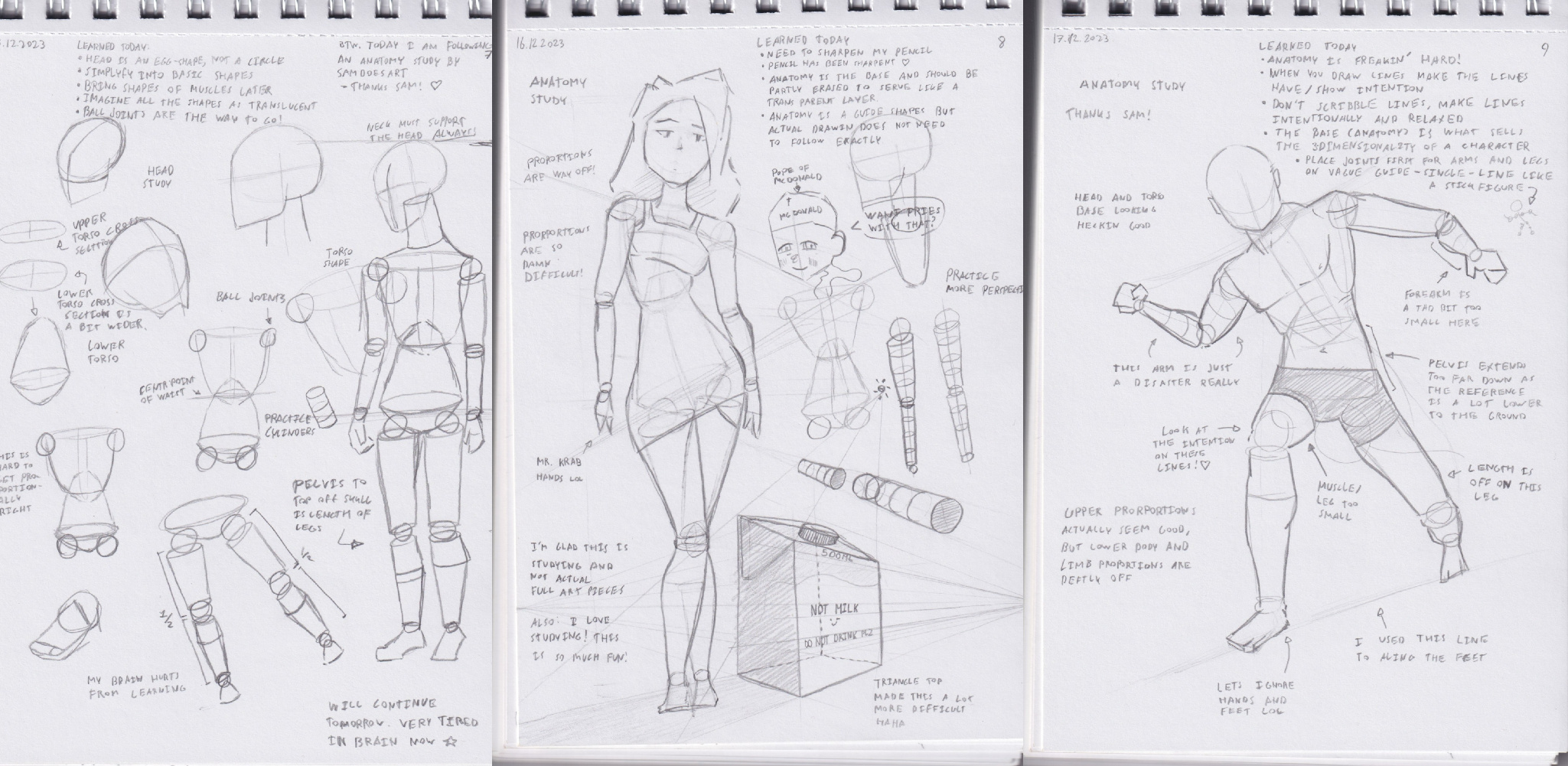
Today I found the YouTuber called SamDoesArts. In his video he mentioned he had a tutorial on anatomy for beginners on his Patreon, so I became a member in order to learn from his tutorials and his studies. I spent day 8 and 9 following Sam's anatomy tutorial. From Sam, I've learned that it's always a good idea to simplify the shapes, before adding details. It's kind of like drawing a 'guide', that serves to help you comprehend and better feel out stuff like 'when are the proportions off?' or spot when for example, the eyes look off, way before you actually draw the eye.
Day 10-12
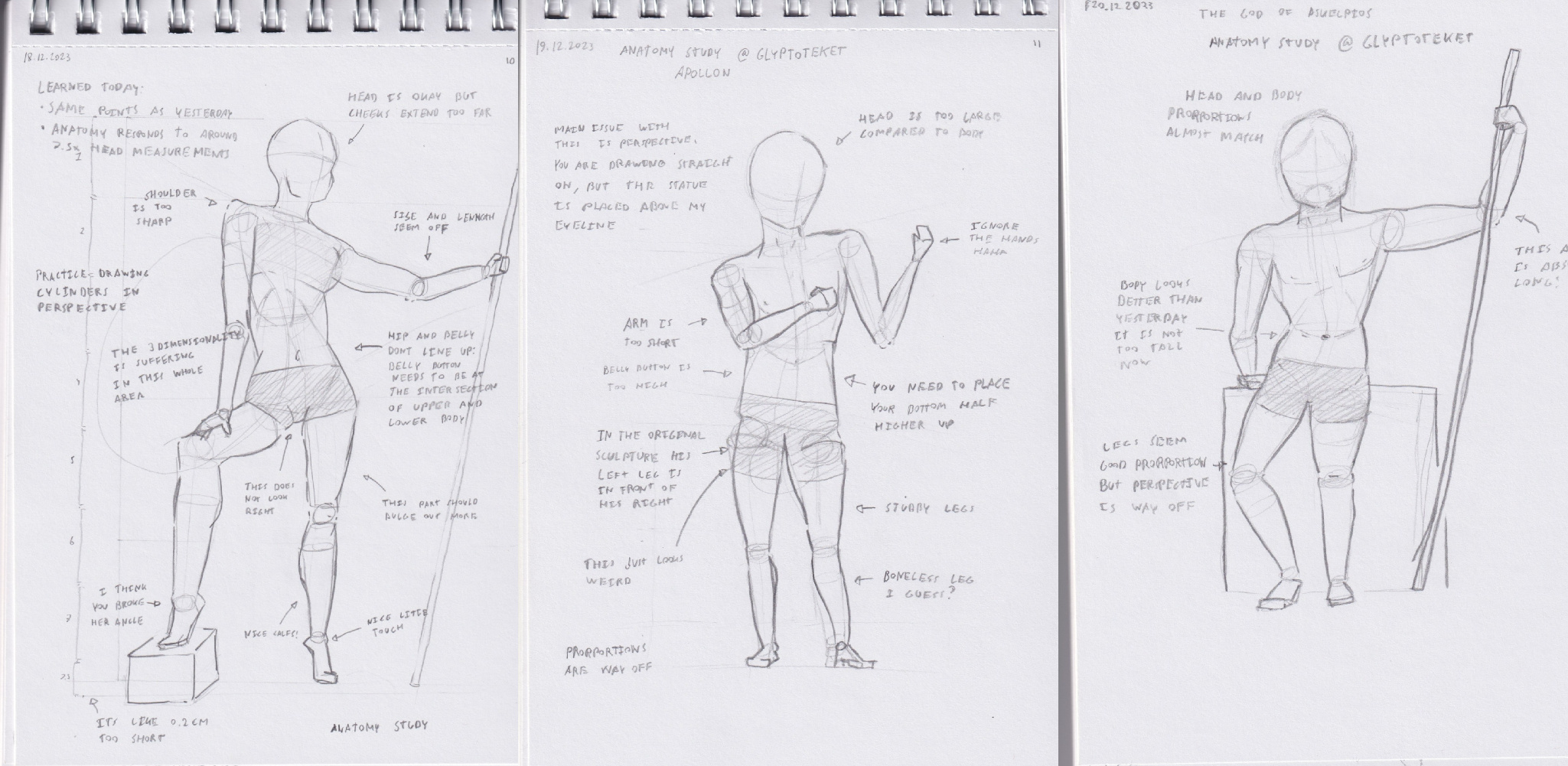
Today I spent my time following Sam's anatomy tutorial while being at the airport, preparing to fly to Denmark for Christmas. Days 11 and 12 I spent at the Danish museum, Glyptoteket, which is an art museum housing sculptures and artwork from ancient mediterranean civilizations. I tried to study the anatomy of Apollon (day 11) and Askelpios (day 12). My main oversigt in my day 11 and 12 drawings, is that I forgot to think about perspective. The statues were up high, and I was looking at them from below, however, I ended up drawing them, as if I was looking at them head-on.
Day 13-14
For the next week I would be in Denmark, constantly on the move, making it hard to find much room or time to sit down and draw. I had to attend different the Christmas dinners of family and friends all week, and only had time to sketch in-between the changes between bus and train stops. Day 13 I spent with some friends, where we decided to have a 30 minute still-life drawing, and on day 14 there was a 20 minute delay on my bus, so I pulled up a reference on my phone, and made a surprisingly well put-together face and expression – though, it was more luck than skill at this point haha!
Challenging excuses / issues with finding time to draw:
It can be difficult to find time for drawing, especially when you have to spend a week, being on the move constantly (even having to sleep on the train). I had prepared for this by having only bought an A5 sketchbook, which allowed me to bring it with me on my travels without issues.
I understand that everyone's circumstances are unique, but in the context of this blog, I will mention, that relying on external excuses hinders pursuing what you want to do. By 'external excuses', I am referring to excuses such as 'I'm just being realistic' or 'I don't have time'. The 'realistic' and 'time' excuse, I would say are the most dangerous, because they sound reasonable on the surface. However, I will dare anyone to challenge all external excuses as unreasonable.
I like to think of it in a bit of a harsh way: Think of all the moments where you grab your phone or turn on your PC to scroll through TikTok or go on PlanetMinecraft (sorry Cyprezz :D ), if time allows for that, why not allocate some of that time to sketching? A thing I learned during my psychology studies, is that if we set a timer on 10 minutes, and actively do that thing for just 10 minutes, we can trick our brains into wanting to continue doing that thing. Its the same mechanism in play, when you scroll through TikTok and all of a sudden, it gets hard to stop and do something else.
Day 15-16
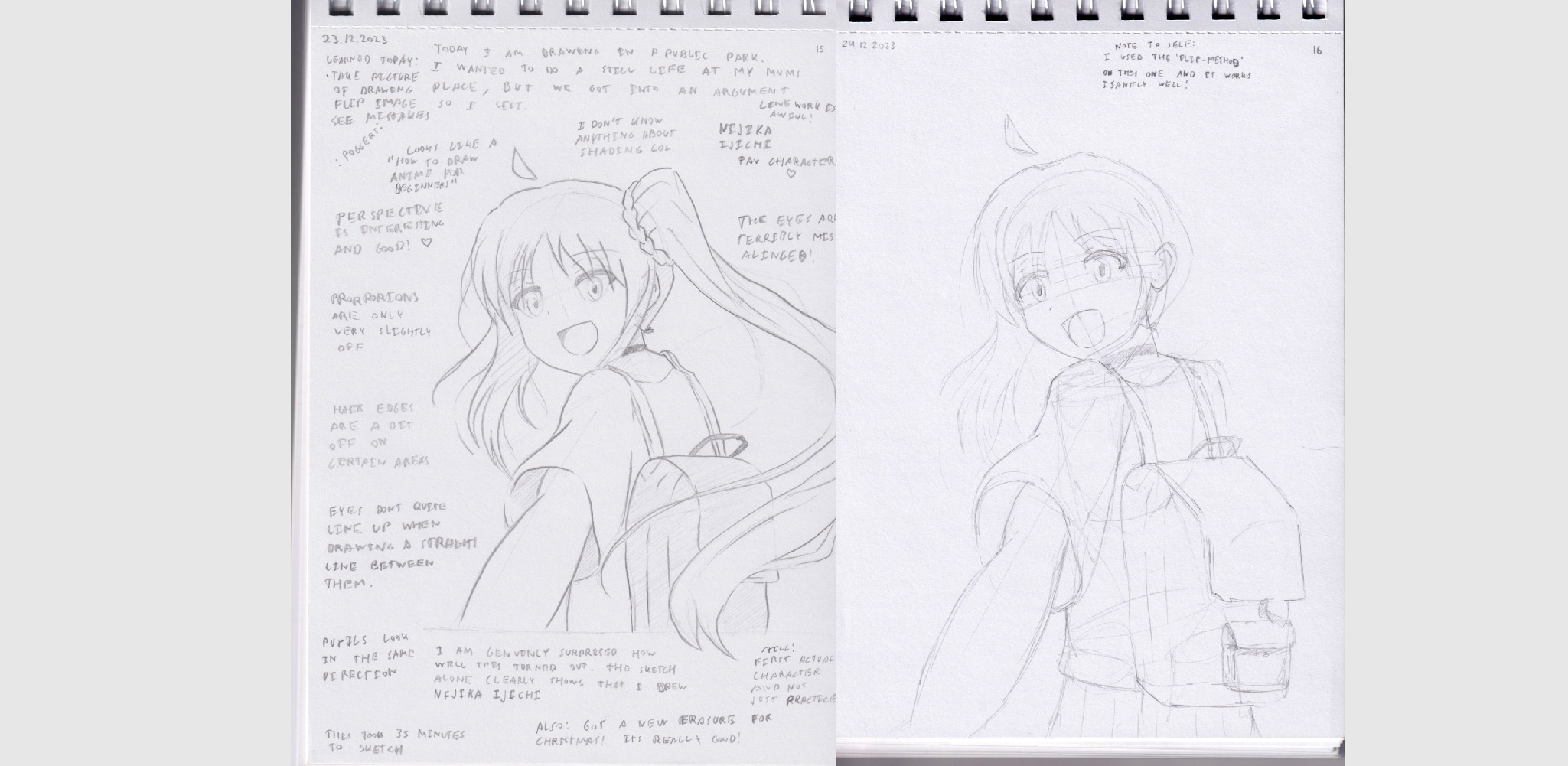
Today I decided to try and draw my favorite anime character, Nijika Ijichi. I had been holding off drawing any of my favorite characters, in fear of messing up. When I was done with the drawing on day 15, at first I actually thought it was pretty good, not realizing I had been hit by artistic tunnelvision. On day 16, when I looked at my drawing from the previous day, I used Sam's flip-method, and noticed just how many mistakes where in my original drawing of Ijichi. I spent day 16 trying to correct some of those mistakes (specifically the eyes) – but it was Christmas eve, so I didn't get to finish the drawing.
(The flip-method is basically that you take a picture of your drawing, and then flip the picture horizontally, which helps you notice (and correct) errors in your sketch, before you get to doing the final line-art)
Day 17-19
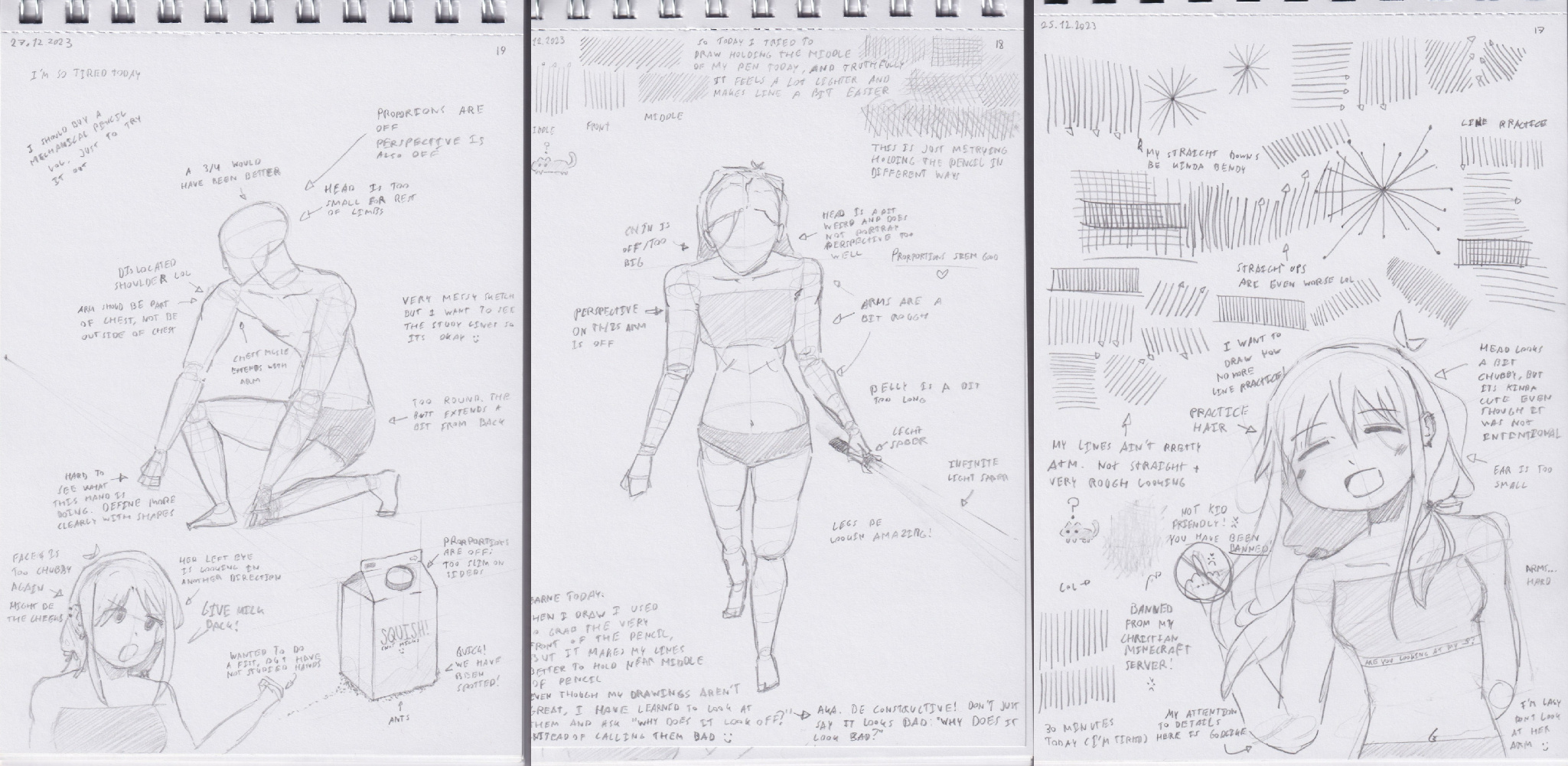
I spent today packing all my things and attending one last Christmas dinner, and ended up packing my sketchbook by accident, so when I finally found it at the hotel I was staying at, the clock was around 22:00, I was very sleepy, so I ended up drawing for 30 minutes straight, and then going to bed. Day 18 I spent wishing my family well, and preparing myself for a 3 hour flight home, however, due to bad wether, my flight got cancelled, so I also spent day 19 at the airport, drawing while watching Sam's anatomy tutorial. Though from this, I learned that apparently, the quality of ones line-work, is affected by where you hold on your pencil (not too sure if this is true or not though, haha).
Day 20-22
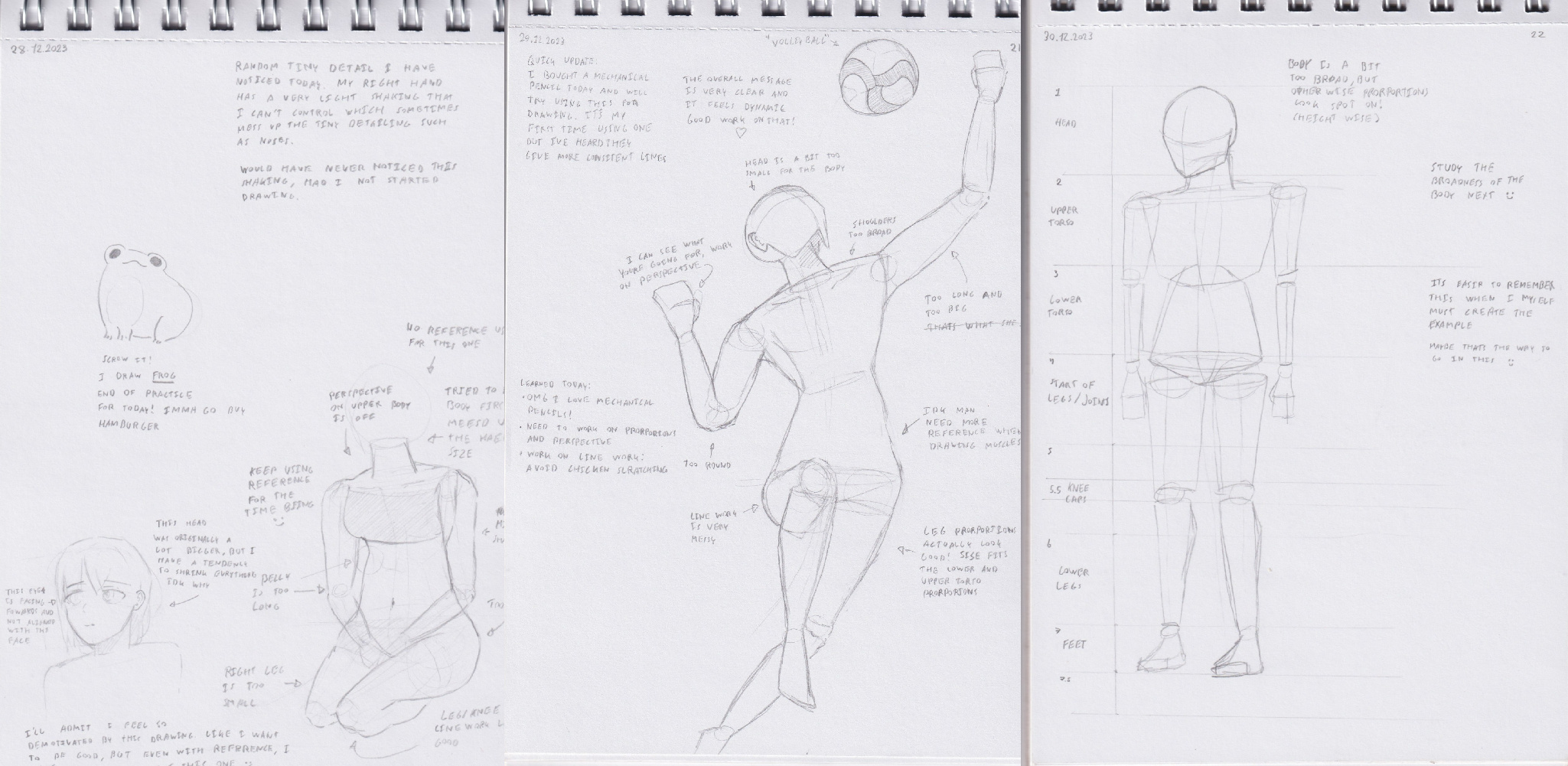
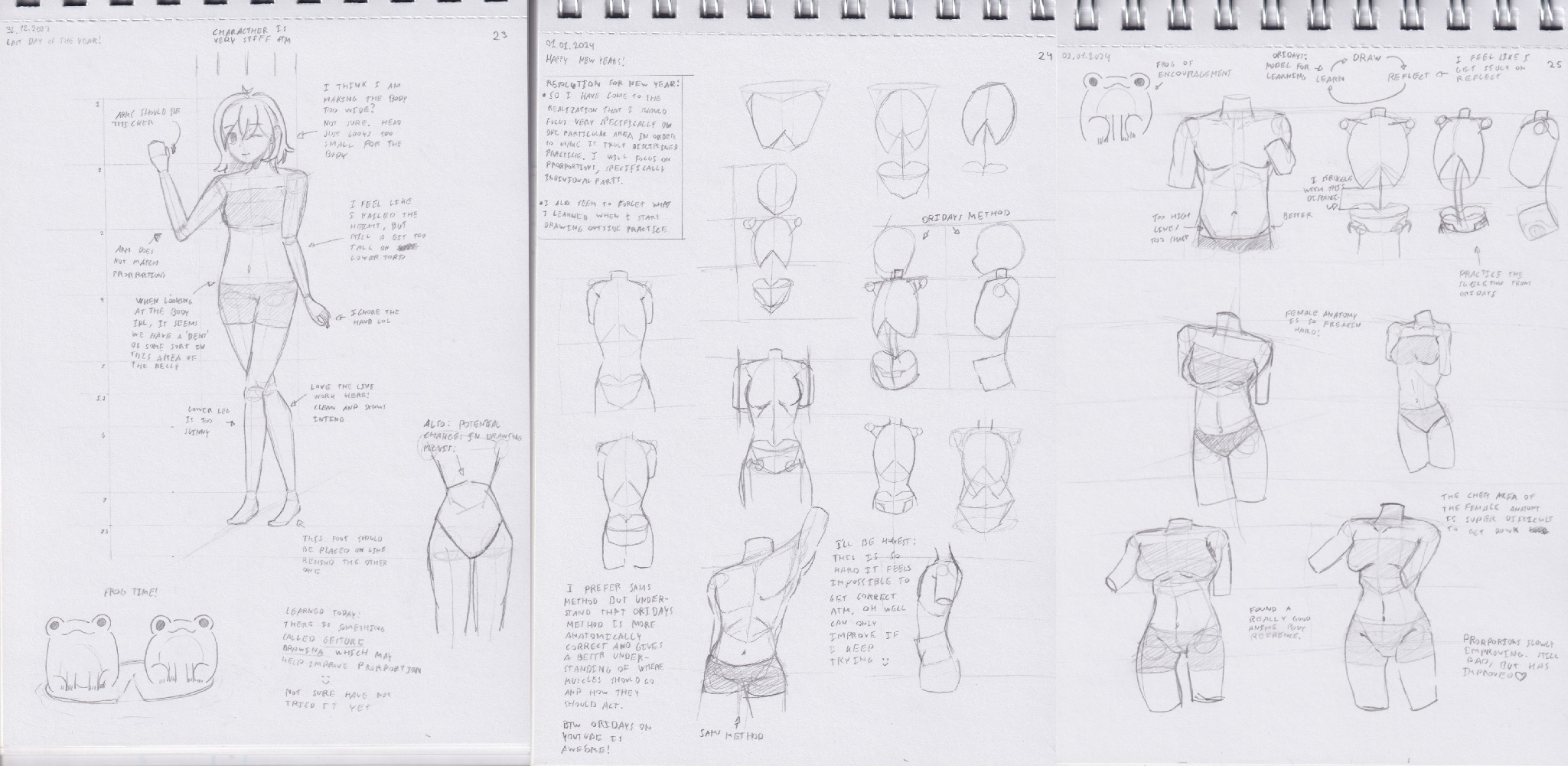
Today was a lot like day 17: I was mentally drained and had arrived home at around 23:00 o' clock. I dedicated the 30 minutes to sketch, drew a frog, and went to McDonalds and fell asleep at McDonalds by accident (I was extremely tired from my trip to Denmark and the flight home). On day 21 I bought a mechanical pencil and tested it using the anatomy tutorial from Sam, and I'll admit, I am a sucker for mechanical pencils now – they are amazing! Day 22 was much of the same, however, I tried to make a full drawing this time. I also did a small line-work test with the frogs on day 22 (mechanical on the left, supermarket pencils on the right).
Part. 3 – Half way, and death – Learning to learn
Day 23-25
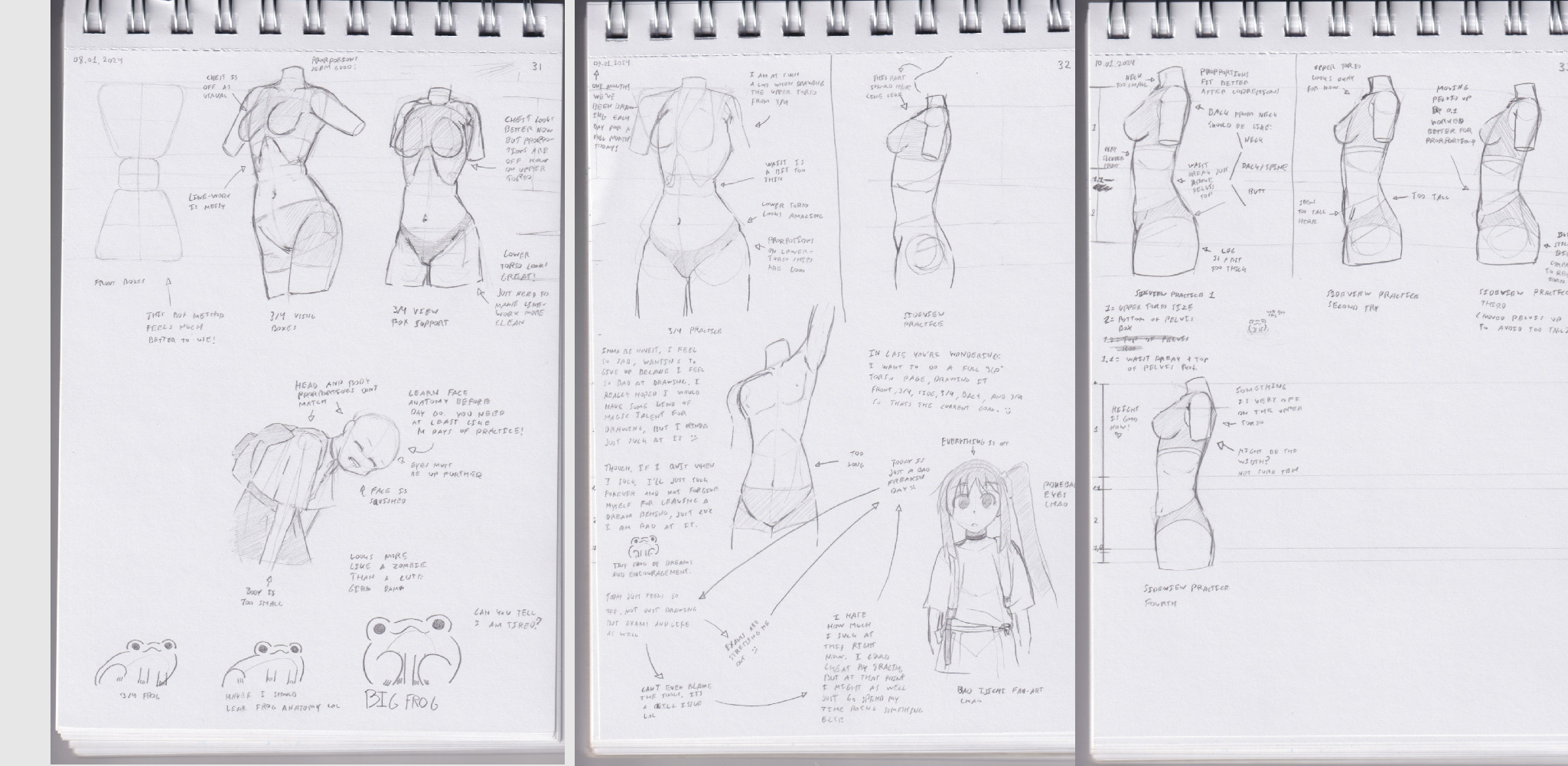
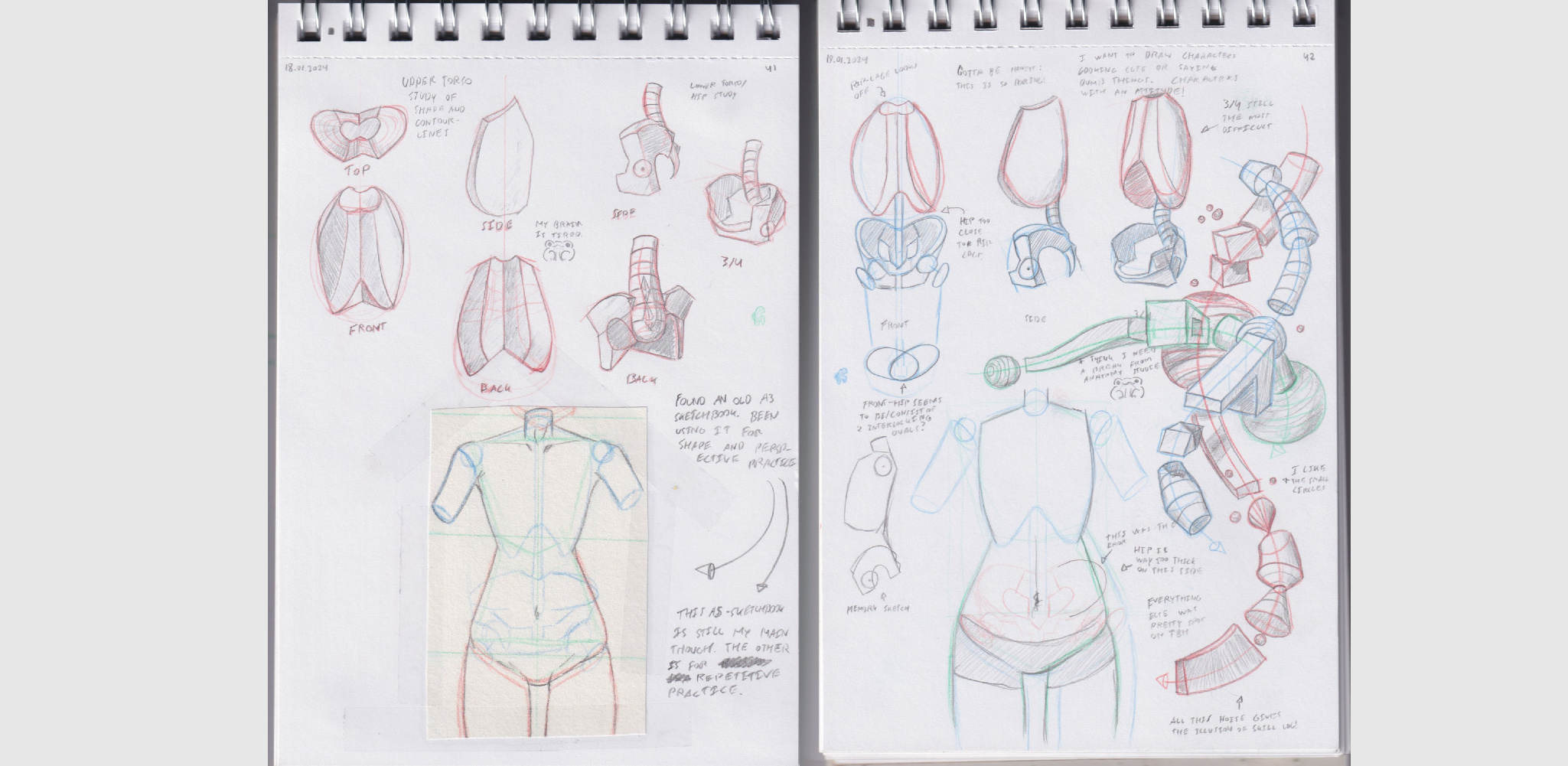
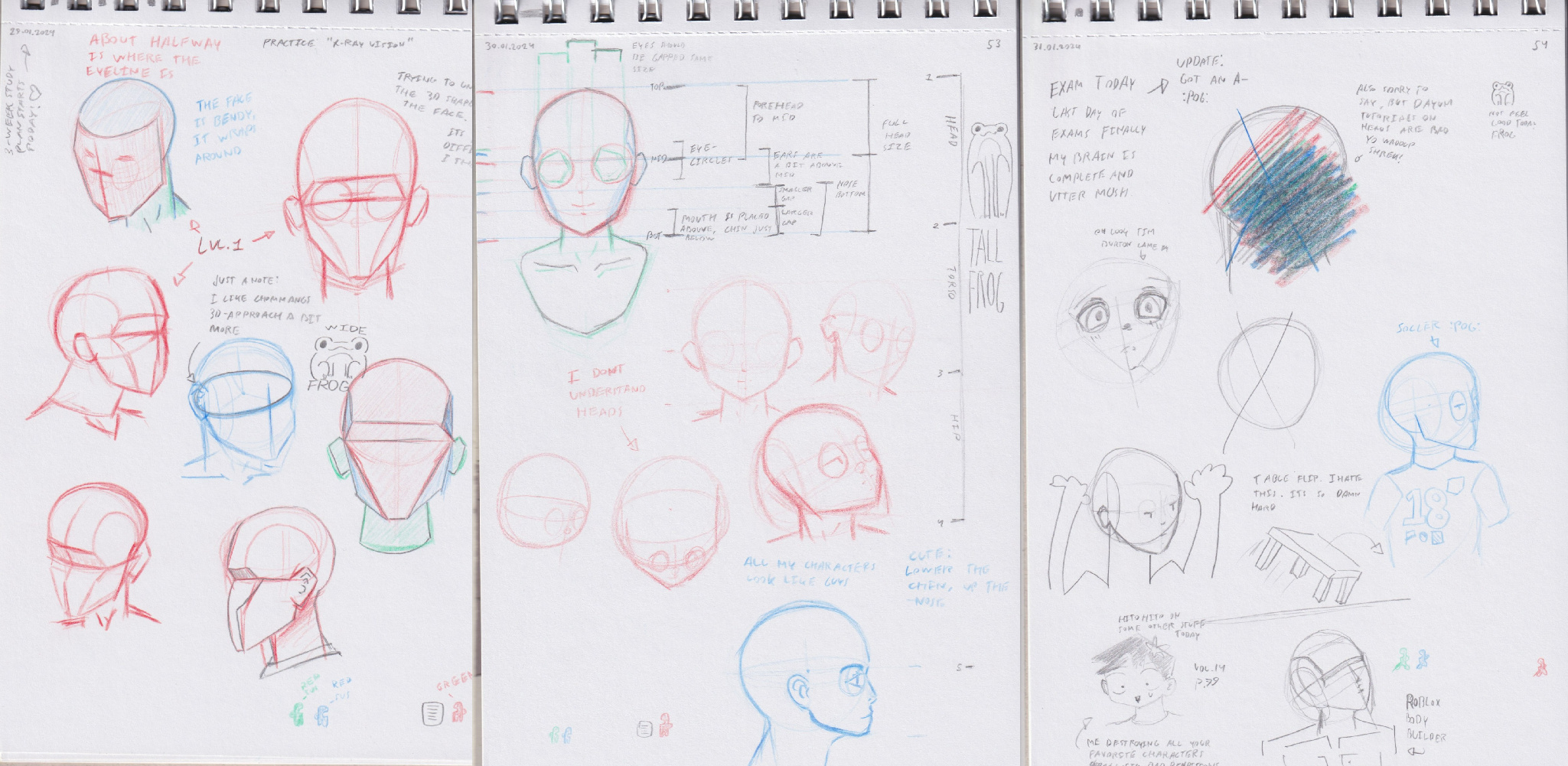
Day 23-25 marked pivotal moments in my sketchbook journey, as I spent my New Years with friends from university. During our New Years party, our conversation veered towards the concept of forgetting (a common tangent in theology studies, surprisingly), which led me to think about my own learning proces during this sketchbook journey. I went through all my previous work and wondered why I kept making the same mistakes over and over again, and realized, I had been so focused on making full drawings, that I had forgotten to focus on the nuances of the individual parts. Therefore, I changed the direction of my learning to favor studies on specific bodyparts – starting with the upper and lower torso.
Day 26-27
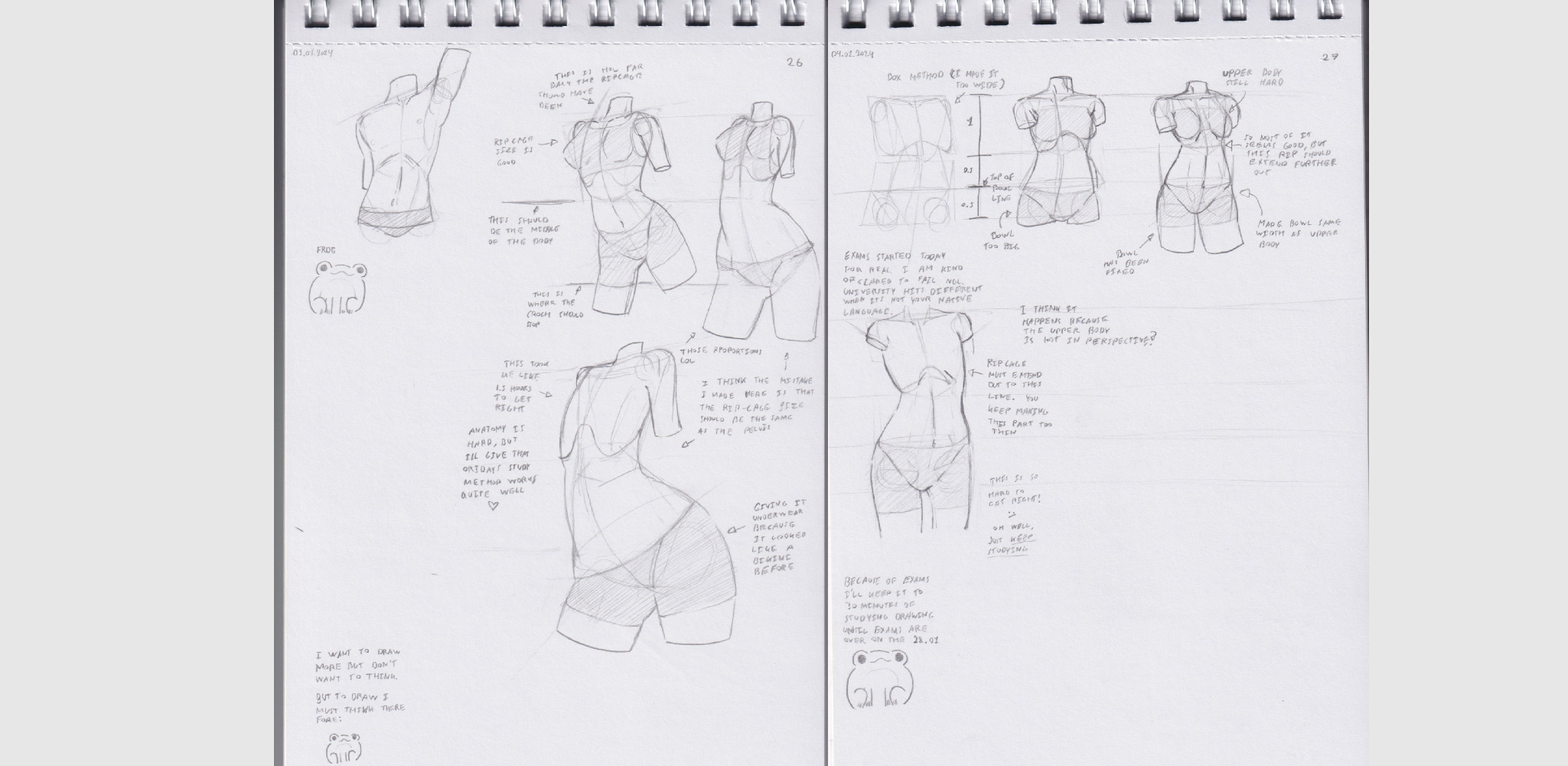
Today I had another epiphany. My exams have just kicked off, and to make matters worse, I moved to a new country in August, and I am not a native speaker here – but my exams must be in the native tongue. I ended up contemplating why my pursuit of drawing matters so much to me, when I clearly have a reasonable excuse to temporarily change priorities. I ended up at a rather uncomfortable conclusion when I realized that my insistence on drawing, stems from the proximity of my own mortality.
Saying that makes it sounds like I am fatally ill, but don't worry! I am healthy, no need to worry. My point is that, despite death being taboo where I come from, it equally acts as a catalyst for commitment to drawing. I grew up with a view of death being something that is either distant or evadable thanks to modern medicine, but now I find death to be an earnest motivator for life. It's sincere and kind, and it urges me you to cherish life itself; to honor the depth and significance of my own and others life.
An anecdote I want to showcase from my theology studies, comes from the first lecture I attended back in August 2023. My professor had just gone through the first part of the lecture, and was starting up on the second part, when he stopped and told us:
“To live is to be on borrowed time. That means the only sin that cannot be forgiven is wasted life. If you feel you’re wasting your life right now, then you have a duty to walk away. I won’t be offended by that, because it means you’re taking your life seriously as long as you have it.”
Initially I thought what my professor said was a quirky theology quip, but I'll admit, that the gravity of what he said, now resonates. My professor wasn't merely highlighting theology's allure; he was acknowledging a universal truth of our finite existence. It's not an admonition to panic if one's life is not how one wants it to be; it's more so a reminder that death nudges us to honoring life's fleeting beauty. It's a invitation to seize opportunities, to create and embrace. Death is often feared, and I don't want this to sound like some twisted 'stop fearing death' speech – I myself am horrified of death. However, what I have realized, is that death has, for me, become an unlikely muse, urging me to live profoundly.
It's not about my fear of the end, it's about cherishing the journey I am on, and the time I have, knowing I am now doing something that I authentically love and want to do – acknowledging just how much I've had to go trough and sacrifice, to get to this realization. That's why, even during the times where I have a good reason, and even a want, to rearrange my priorities; drawing will always stay at the top, all the way until my brain shuts off.
Day 28-29
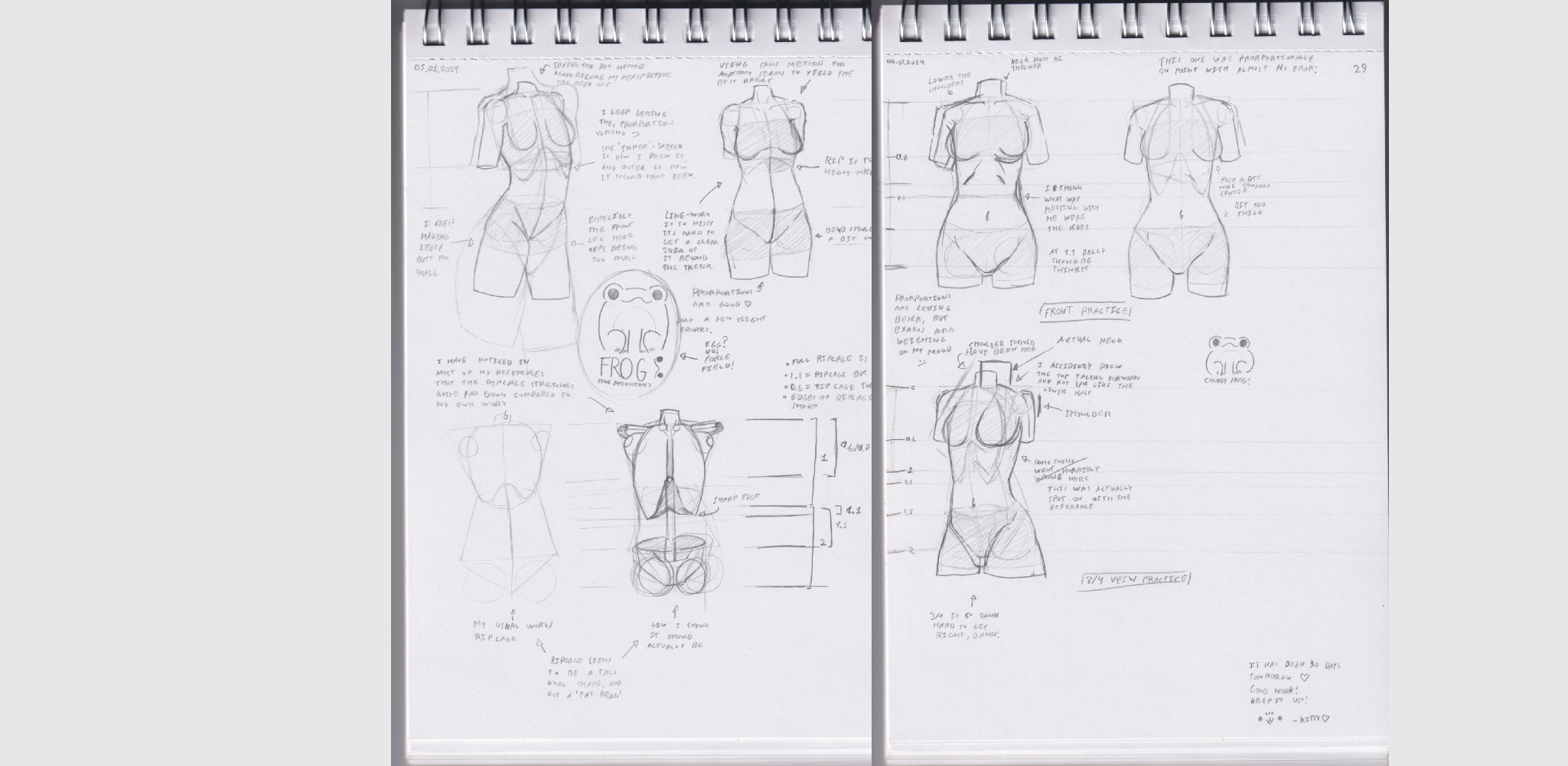
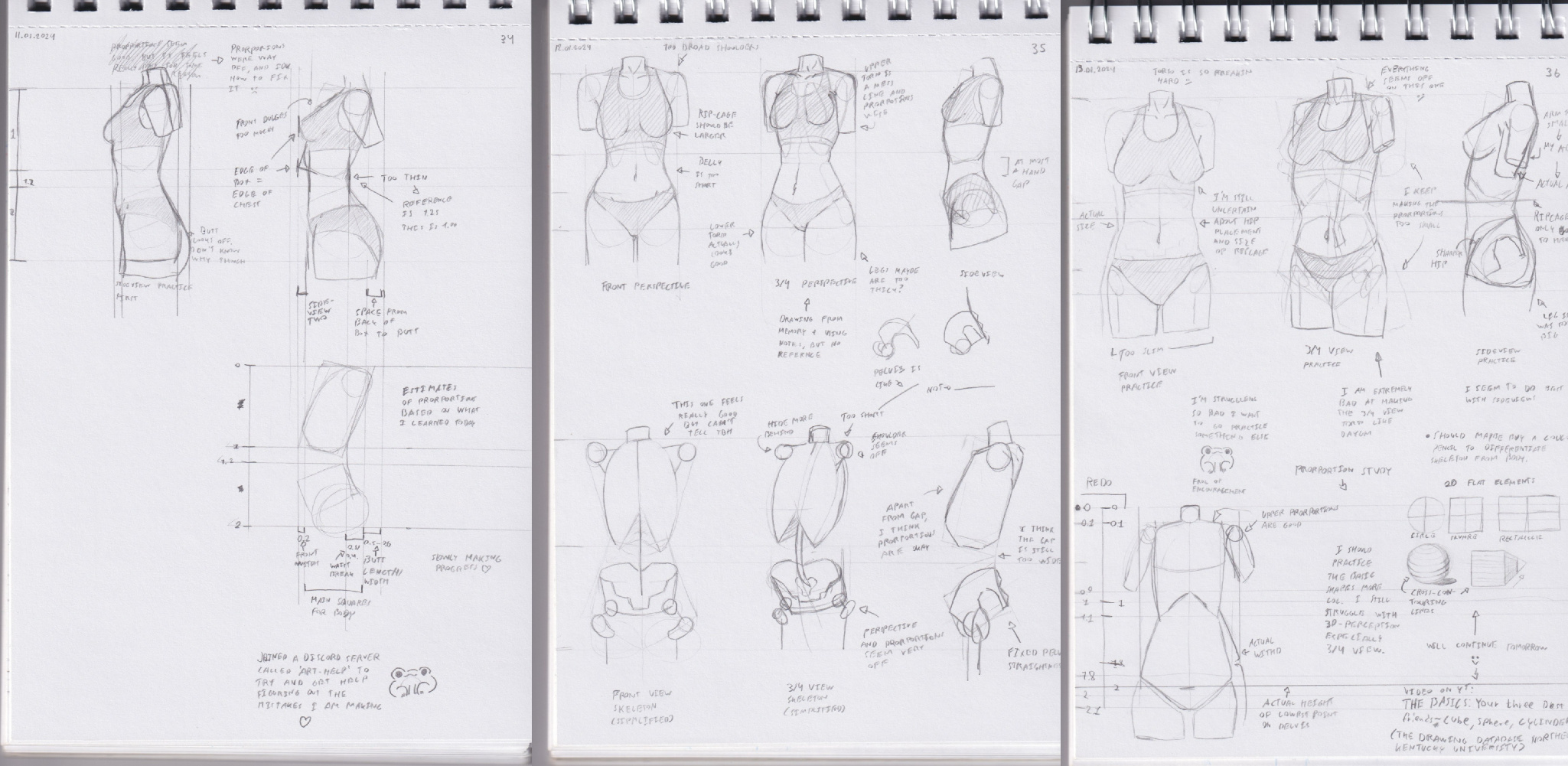
Today I tried to figure out what I was doing wrong in terms of proportions, and ended up doing a study of the human skeleton in the upper and lower torso, which helped me realize that I have been making the rip-cage way too short. I spent day 29 testing my study, and noticed my proportions had actually gotten a lot better.
Day 30 – The half-way mark!
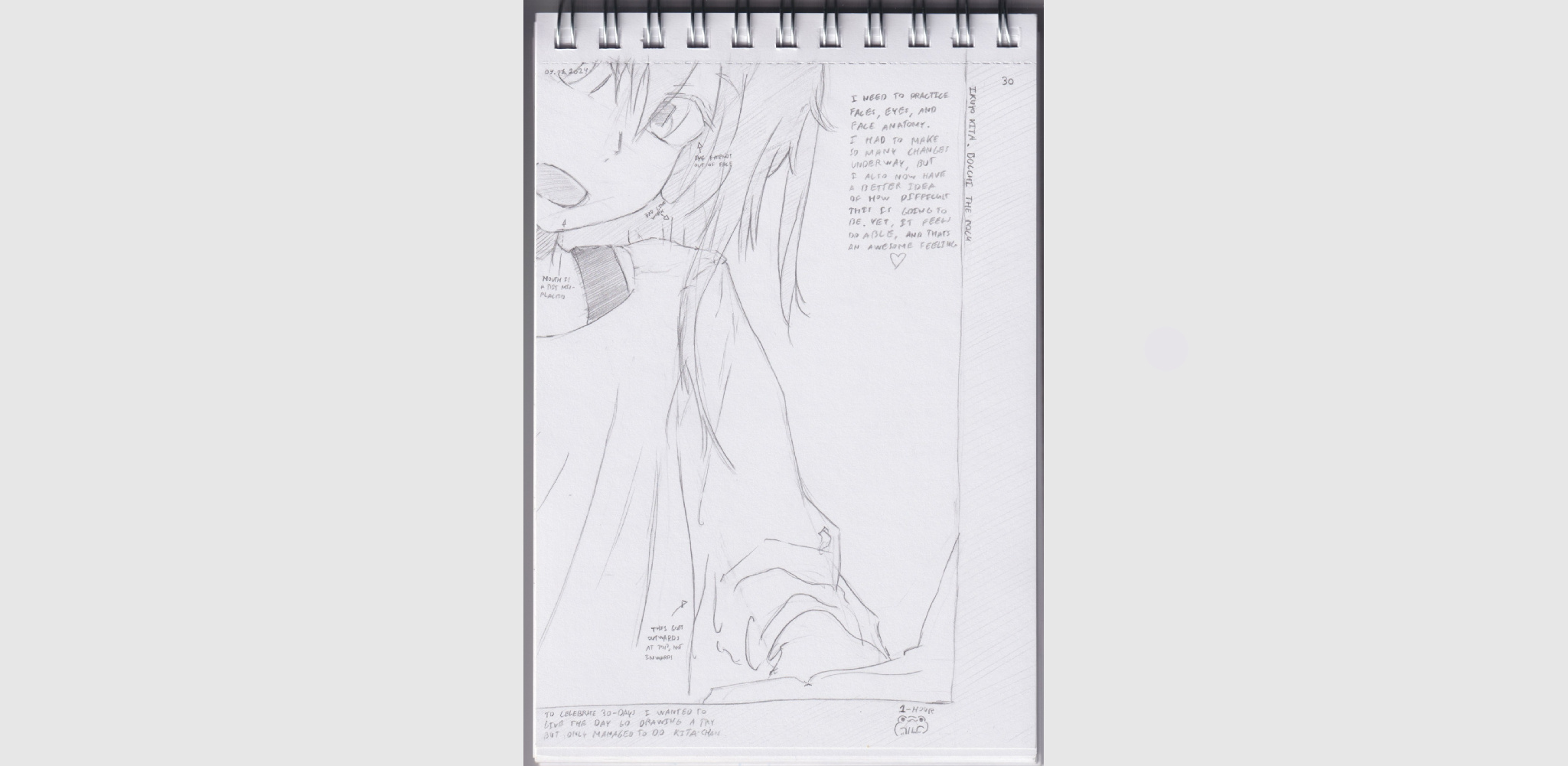
Exams are still ongoing on day 30, but I wanted to celebrate getting this far by trying my hand at the goal for day 60! I will admit that after an hour, having only finished Ikuyo Kita, I was too tired to continue because I had to make so many corrections to this drawing (especially her face). However, compared to my drawing of Ijichi from day 15, this was a good improvement!
Day 31-33
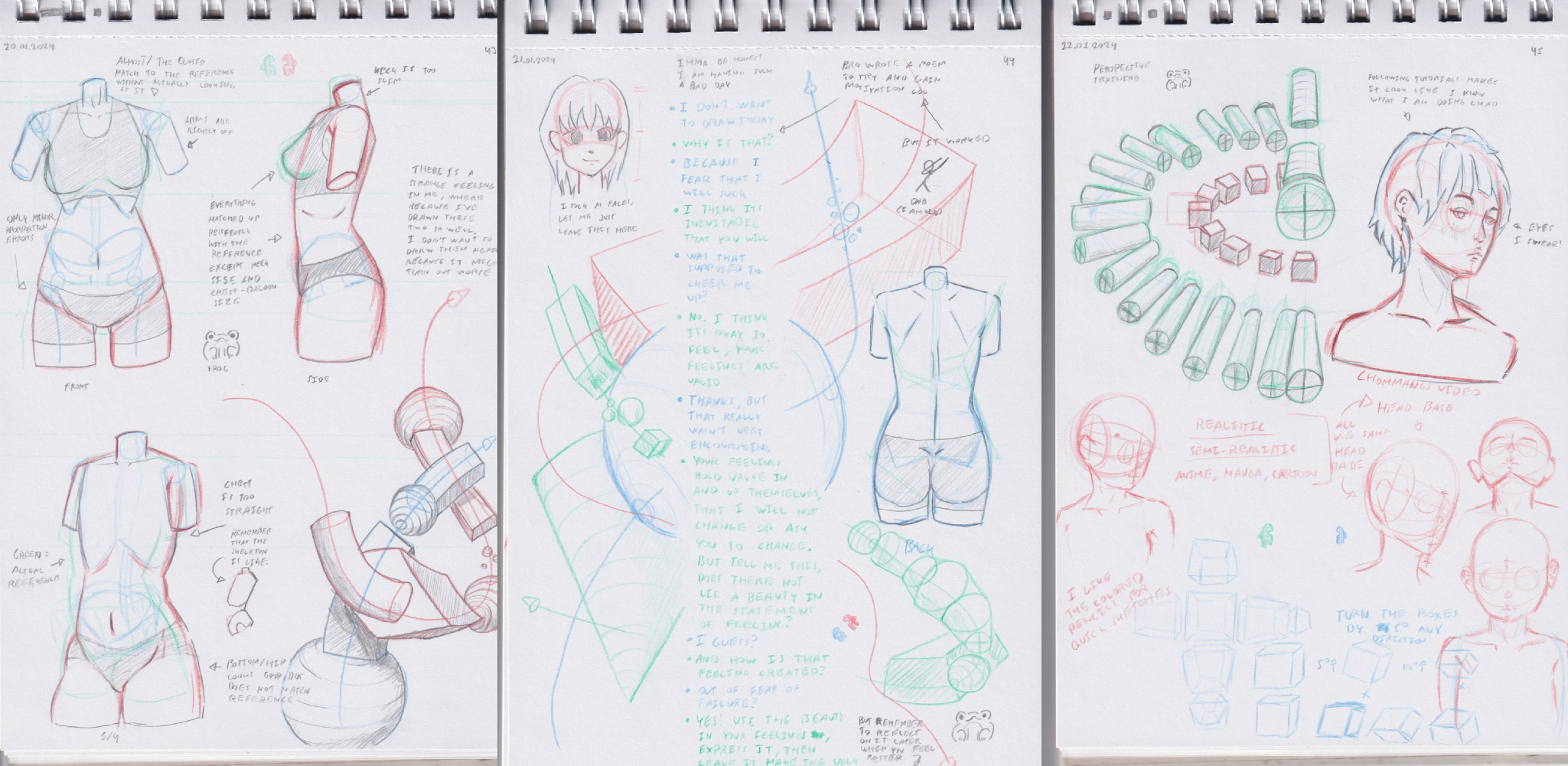
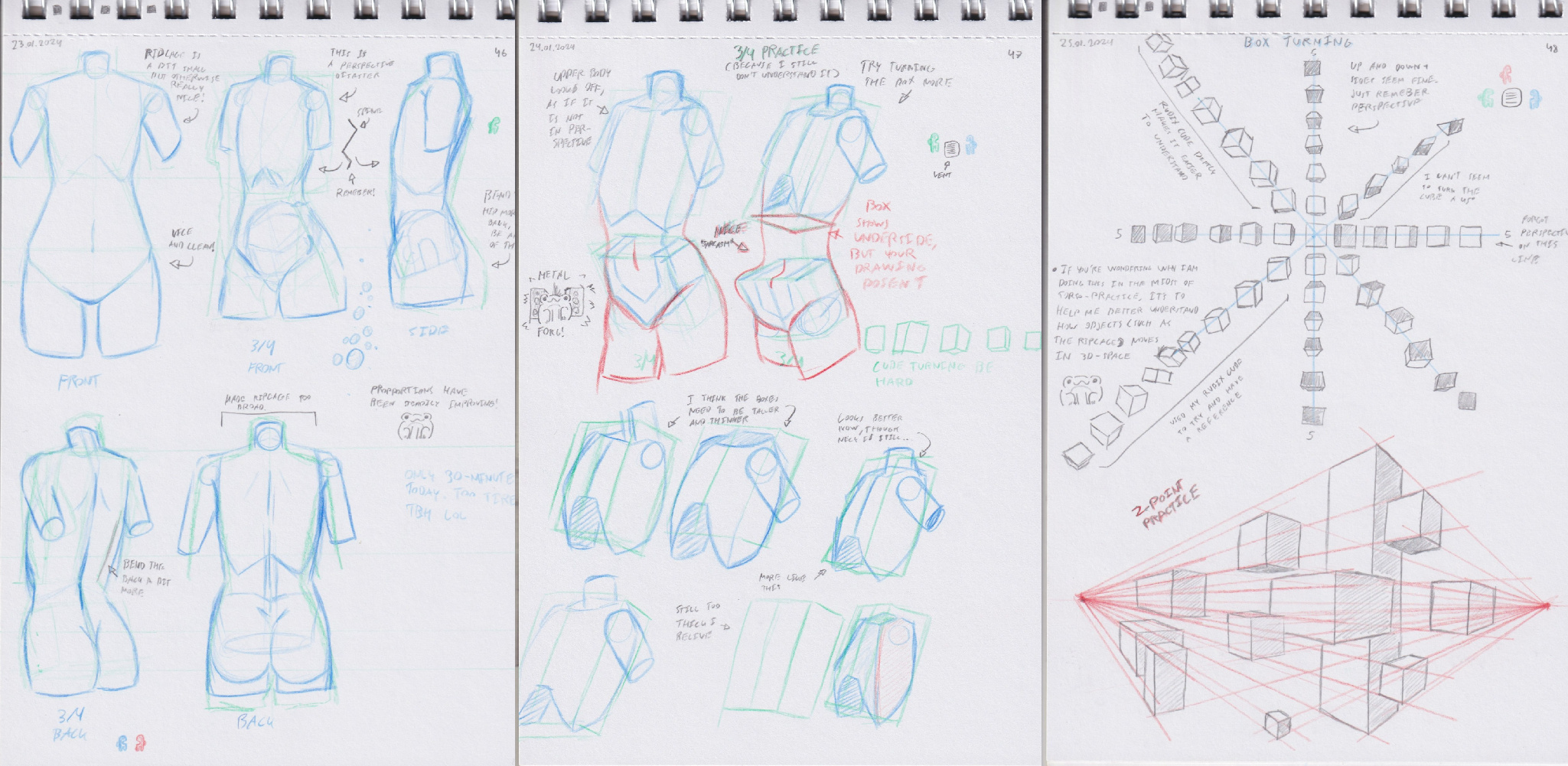
I spent most of today digging into the 'draw → reflect → learn cycle', doing my absolute best to try and learn the nuances and proportions of the upper and lower torso from different angles. Though this is also the point where I really began feeling at my lowest, because I was struggling with the proportions so hard, that I got genuinely sad over just how awful these drawings are. But, no matter what, if I quit while I'm bad at this, then I will forever be bad at it. So nothing to do, but keep practicing!
Day 34-36
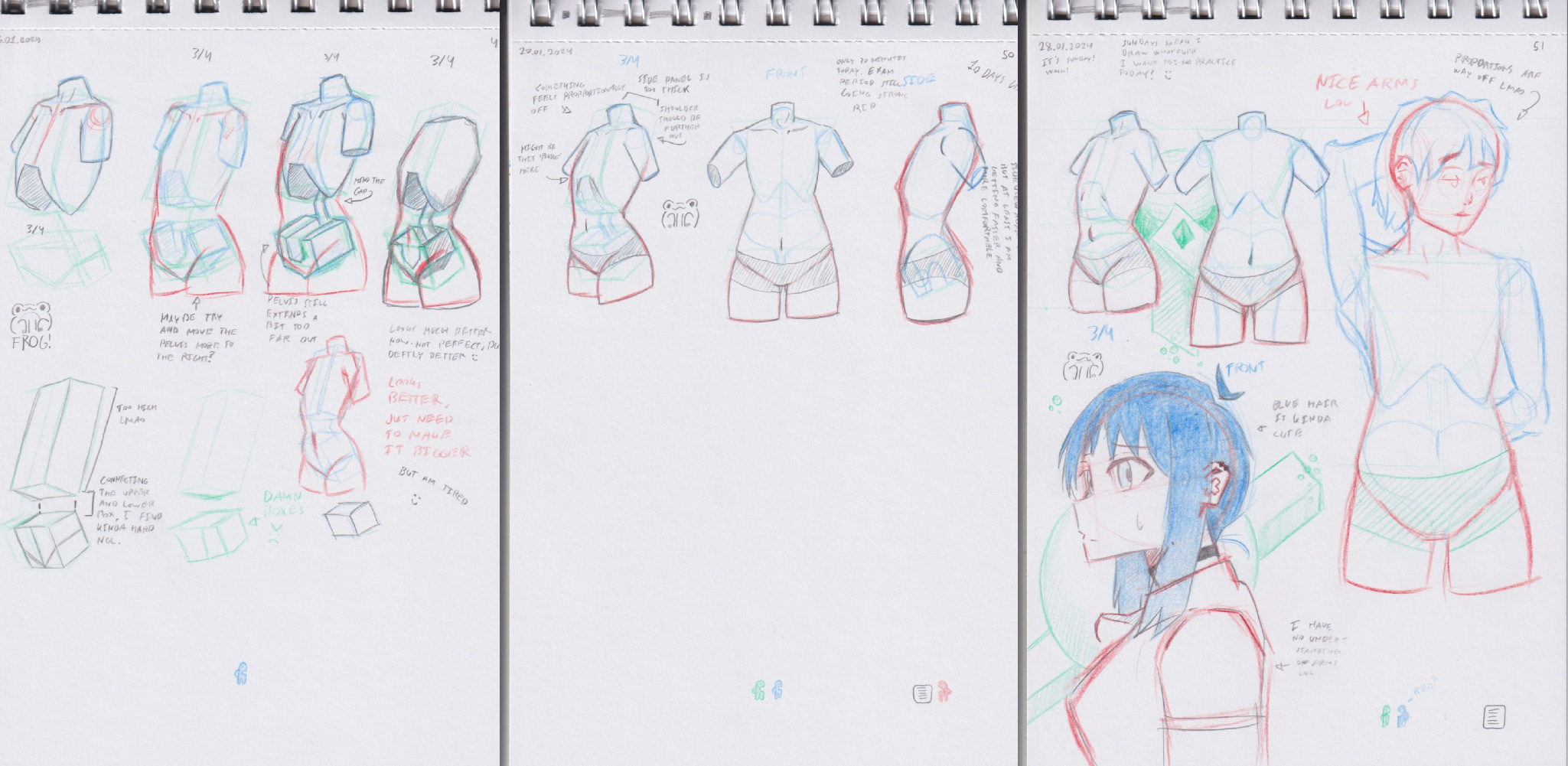
Today I got stuck, trying to figure out what I was doing wrong, because the sideview proportions never seemed to match up with the references I used, when I overlaid the two. I ended up creating a new Discord account and become a member of an art-help / feedback community. I sent my drawings from day 34, and asked for help. The next day, someone had responded, and pointed out two major issues: 1. I was making the gap between the torso and pelvis too large, and 2. I was not orienting the pelvis slightly down. Turns out: The human skeleton have a lot more nuance than I the simplified shapes of drawing tutorials have haha!
Part. 4 – Calls for a new plan – Hitting my lowest point
Day 37-38
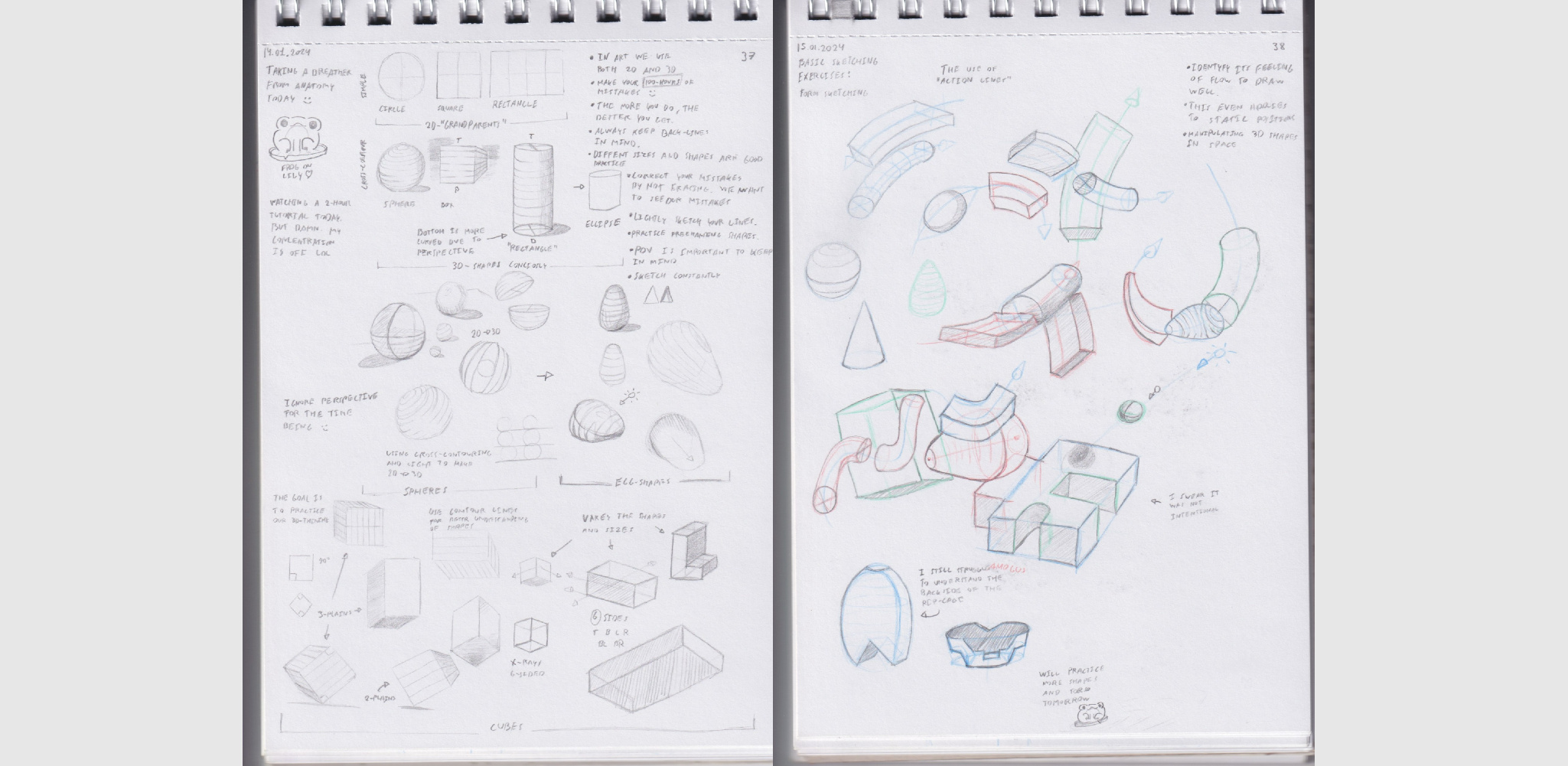
I spent day 37 and 38 taking a breather from learning the anatomy of the torso. I got a tutorial recommended on the Learning-to-Draw Discord server, which was an in-depth look at the basic shapes: Sphere, Cube and Cylinders. I probably should have started with this tutorial, but at least I now know of its existence haha (The Basics: Your Three Best Friends-Cube, Sphere Cylinder). I also bought a red, green and blue color-pencil on my way home from uni because it annoyed me that I couldn't tell what was back-lines, while doing contour-lines.
Day 39-40
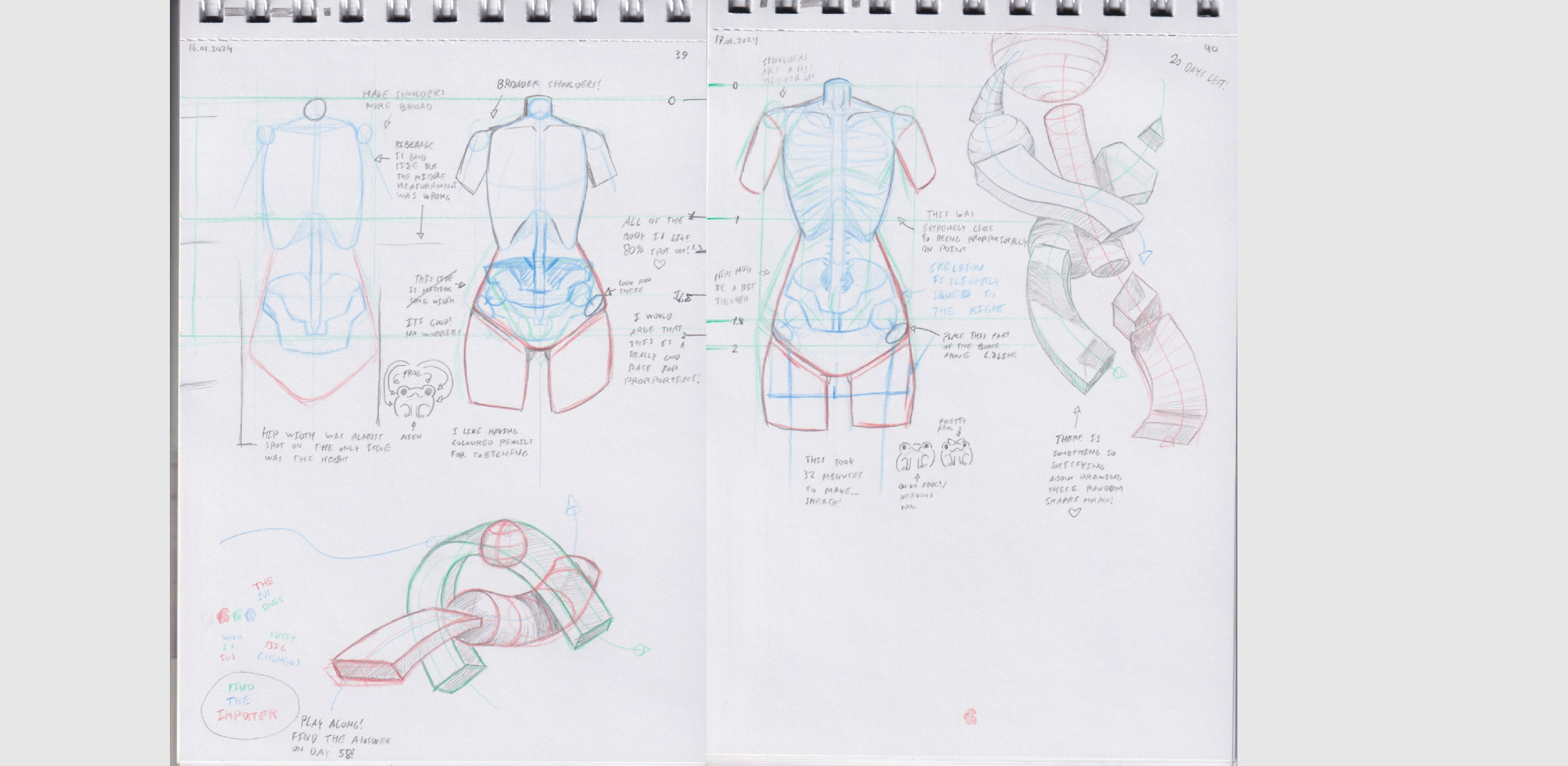
Today I spent most time doing a mix of studying the skeleton and just doodling the basic shapes, in accordance with the action-lines. Sort of like at the beginning of this sketchbook journey, I have no sense of direction for what to actually do with this – but it's important, so I will keep doing it.
Day 41-42
Today I was cleaning out an old moving-box where I happen to find two unused A3 sketchbooks. I originally bought them for taking notes during lectures, but never used them, so instead they have become my 'repetitive exercises'-sketchbooks – basically the sketchbooks where all I do is draw circle after circle after circle – the kind of practice that is more so targeted towards training the mobility and movement of my hands, rather than actually studying.
I also started breaking down the skeleton and making front, side, back and 3/4 views of them, in order to understand their 3-dimensionality. On day 42, in my A3 sketchbook, I also made my first OC character (The blue haired girl). I haven't given her a name or even fleshed out her design, I just got bored of studying and draw a random character, that I ended up really liking, and wanting to do a full piece on some day.
My brain / perception is slowly changing:
Through consistent practice of drawing basic shapes, there has been a shift in my approach to visualizing objects. Now, even when sketching seemingly flat/simple shapes like circles, my mind instinctively interprets them as three-dimensional spheres, with an awareness of their spatial depth. This 'transformation' has enhanced my ability to comprehend and represent complex forms, such as the ribcage, as I now intuitively recognize the interconnectedness of lines and contours in both front and back views.
Day 43-45
Today you can see my fear of failure begin to show, something that hit me incredibly hard on day 44. I began to feel the full weight of the fear of failure, as like an apprehension or anxiety about not meeting my own or others expectations, leading me to be very reluctant in engaging in drawing, due to the potential of my perceived inadequacy or disappointment in my own work.
Talking about the fear of failure:
The fear of failure is the apprehension or anxiety about not meeting one's own or others' expectations, leading to a reluctance to engage in a task or activity due to the potential for perceived inadequacy or disappointment.
I don't think the fear of failure should be stopping a person from pursuing something like learning to draw. It's a common emotion that many individuals experience, especially when learning a new skill, or engaging in creation. I feel, that instead of letting fear hinder your progress: Try and consider reframing it as an opportunity for growth and learning by embracing mistakes as part of the creative process.
Use the mistakes that trigger the fear of failure as part of the learning proces; use them as a lesson to improve your skill. Failure is NOT a permanent state: It is a stepping stone towards improvement and mastery – and feeling the fear of failure, is a reminder of this beautiful aspect of learning. Push through the fear! I promise, it will lead to valuable experiences and development.
Day 46-48
With the fear of failure still lurking in my mind, I decided to research a bit on how professional artists study, and stumbled over a video by goblish called "The Best Way To Practice Drawing". The video inspired me to try and give my studies more structure and a time-limit so to speak, which resulted in me creating this 3-week study plan that I printed and hung on my wall:
After putting this up on my wall, I felt a lot more at peace because I now have an actual plan that gives space for fun and repetition of what I have been learning up to the current point (also, you're reading it right: I got accepted into a 3-month art-school course!).
Day 49-51
There are still a few days before my new study plan starts, so I decided to go back and look at what I struggle with, and realized that especially the 3/4 view has been difficult for me. This is when I discovered the magic of using boxes as guides for perspective. On day 51, it was a sunday – which meant it was a fun / free drawing day, so I decided to try and redo my unnamed OC again – and it went surprisingly well (if you ignore that her chin resembles more that of a horse than a human haha!).
Day 52-54
Today the new study-plan started, and the first 3-weeks will be spent, learning how to draw heads, as I have been struggling with getting the proportions of the head to look good. Just like the approach I learned from SamDoesArts, I started by learning the simplified shapes of the face, in order to gain a better understanding of how these shapes would affect stuff such as eye, nose and mouth placement, from different perspectives. Oh, and day 54... It was not a very good day, because I felt that I had just gotten a lot worse at drawing all of a sudden.
Day 55-56
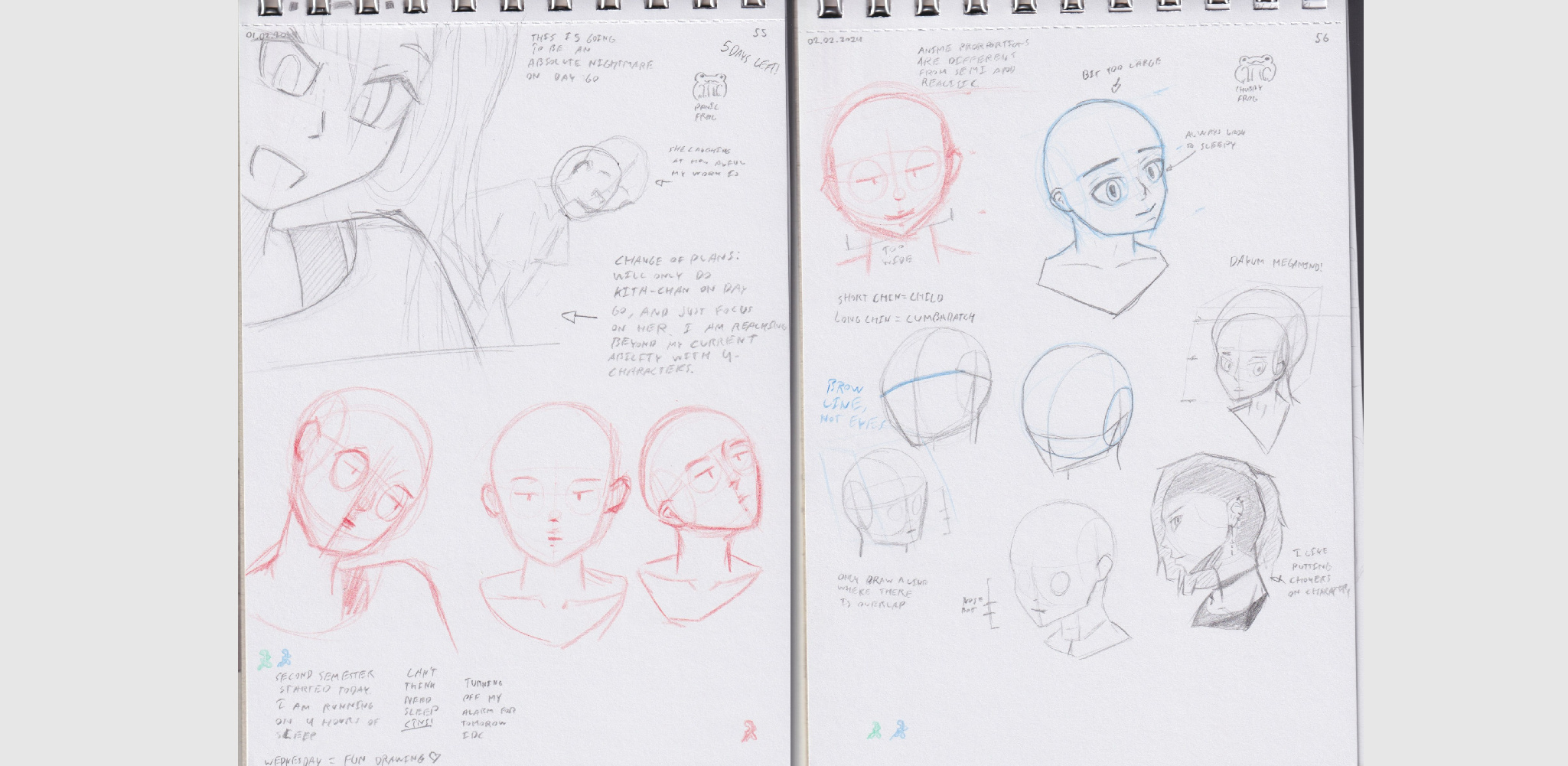
At this point I was starting to panic. My understanding of heads and faces are, to say the least – lacking, and when I tried to practice the day. 60 drawing (which is now 5 days away), I just could not get it to look good, no matter how hard I tried. So I spent day 56 practicing heads and faces in order to at least have a vague chance of success on day 60.
Day 57-58
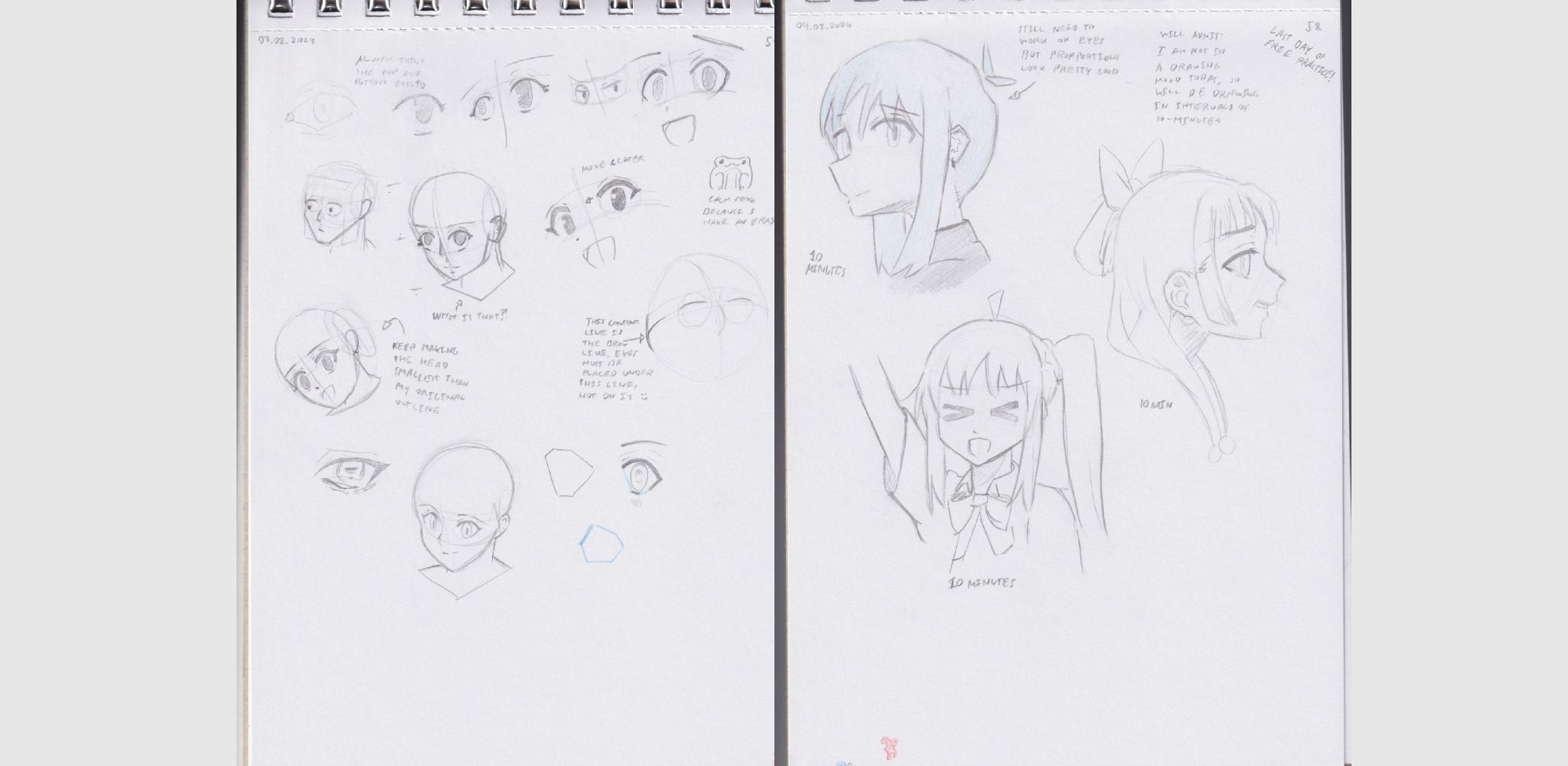
This is 'the end' of free practice so to speak. Tomorrow its day 59, where I will have to redraw Nijika from day. 15, and in 2 days, it will officially be "the end" of Sketchbook Journey I. I spent today practicing faces and face proportions on heads. I am aware that I especially have issues with foreshortening of the eyes, and that I keep making mistakes with the general proportions of the face. Hopefully, I will be able to manage!
I have also noticed, that I still mistake the brow-line for the eye-line when I draw. This is equally something I need to work on more haha.
Today is the day I have been most excited about – I will be redrawing the picture of Nijika Ijichi from day. 15, and compare the two. When I finished it, and compared to to my work on day. 15, I was so glad to see, that I had made some big improvements! That is not to say that my drawing here on day 59 is perfect, as I can point out the left eye should be more foreshortened, the proportion of the arm coming towards the viewer is off, and while there is more movement in the day. 59 version, compared to the day. 15 version – its still lacking compared to the reference I used.
Day 60 is today, and I just finished the final piece. I find it quite hard to think that it has already been 60 days. I will admit, that my understanding of faces and general proportions are still extremely off, and there are some major errors in the final piece. However, I am happy with the final piece, not because its good (honestly, I feel my work on day 59 is way better), but because I actually drew it without tracing anything, and because I can see both how much I have improved since day. 1, and I can see, how much stuff I need to work on in the future haha!
Closing Remarks
Thank you so much for reading
If you have any questions or tips, feel free to ask me on Discord :)
Random thoughts from the past 60-days
– Thoughts that I found interesting in their own right, but didn't really fit into this entry.
Nuggets of advice I like
When you start off, it can be hard to formulate specific ideas and preferences because there is so much to making art of any kind. It's okay to lack clarity or even direction –
find some creators you like and follow them. If they make tutorials: That's even better!
Learning basic shapes,
it's more about training your brain to think in a certain way;
moving away from the 2D thought of drawing, to almost intuitively thinking of something like the skull's 3-dimensionality, when you draw portraits.
Instead of thinking of just drawing a circle for the head, think of the head as a skull in 3-dimensions:
it needs space for the brain, it's an oval from the side, the hair sits above the skull, hair doesn't grow from the skull.
The more you draw, the better you get –
that's also why it has been so important for me to spend these first 60-days, adapting and adjusting my daily life to include the 30-minute drawing session.
So practice just sitting down and drawing every day, for however long suits you.
As little as 5-10 minutes every day is more than enough to slowly improve.
In addition to this, I really like the saying
"Make your 100-hours of mistakes",
as a reminder that it takes time, and that with learning to draw, we must equally practice the patience we have for ourselves, and our current capabilities.
"Artists observe, while others view".
I like this phrase because it
suggests shifting from a casual and passive viewing of what we draw, to a more focused 'observation',
where we analyze and think 'where would the ribs be in this statue?',
breaking what we view into simple shapes, and noticing the smaller details of for example eyes.
It should go from the casual view/concept of 'an eye' to 'What shapes and parts make up the eye?'.
Use 'Draw → Reflect → Learn' cycles as you get better.
It's especially helpful if you're having a hard time getting useful feedback.
This way, the reference itself that you are using, acts as instant feedback on your work, when you overlay the two.
Use the flip-method to avoid artistic-tunnel vision,
especially if you intend to make your sketch into a full-piece.
Join an Art-help community.
Any community, even PlanetMinecraft can serve as a good place to get feedback on your work.
It's especially helpful if you feel stuck, or don't know what the next step in your own sketchbook journey should be.
I use Discord and joined a semi-large Art-help server called 'Learning to Draw'. Feel free to come say hi.
I'm usually active in the #art-help channel. Join here.
There does not exist one single "big secret" that will make you become better at drawing.
Instead, art seems to consist of many many different smaller pieces.
A single puzzle piece, even if it represents only 1% of the entire picture, might go unnoticed individually when the full picture is visible.
Yet, you'll always notice if that one piece is missing in the final puzzle.
Some harsh words of encouragement that I have been really fond of all the times that I've looked at my work and thought "I am terrible at drawing",
I remember the words of VTuber Mori Calliope:
"If you quit when you suck, you'll suck forever".
"We don't draw from imagination, we draw from memory".
It's a very 'square' way of putting it, and it shouldn't be taken as an absolute,
but it's a good reminder, that when we look at artists who can draw something incredible, without using any guidelines, boxes or shapes –
they are not pulling these from their imagination, but from their memory of having drawn countless guidelines, boxes and shapes.
Future goals
Digital or traditional? (Investing in a drawing tablet):
I've been contemplating whether I should've started digitally instead of drawing by hand. However, instead of dwelling on that, I've set a new long-term goal and reward for myself: when I reach a point where I'm confident in my ability to draw characters and poses, I'll treat myself.
The timeline isn't the concern; what matters is achieving that goal. Once I prove my capability, I plan to invest in a high-end 500€ drawing tablet with all the bells and whistles. It might mean starting over in a sense, but that's a future worry!
My best estimate is that this goal will probably first be reached in like 1.5 years or so haha!
As for whether or not I should have started my journey making digital art, I'd say it was the right choice to start with drawing by hand, as it's much easier and more available—just going to the local supermarket and buying some cheap equipment to get down the basics. Then, as I get better, I will equally have more time to learn about different art materials, instead of binding myself to one from the get-go :)
More fan-art!:
I've come to realize the importance of drawing characters you like, so I'll be focusing much more on drawing and studying characters beyond just Nijika Ijichi—though she is still my favorite, so I will definitely be drawing more of her as well haha!
I want to try and draw all the different characters from the Bocchi the Rock anime, as well as dive into doing studies on characters from the KonoSuba anime—specifically focused on the character Megumin, because of her distinct clothing, smaller height, and assets like her staff.
I got accepted into a 3-month manga-drawing course:
I actually found out there was an art school near my university, and noticed that they offered a 3-month manga-drawing course. I have no idea at what level it is, but I will be attending actual art classes from February!
Honestly, it's a dream come true finally being able to say "I attend art classes"! It's only once a week, but still! What perfect timing!
It's not cheap though, so I have had to cancel my bus pass and climbing membership, because I can't handle a second job on top of my studies and current job haha. But it's worth it—it will be worth the sacrifice :D
Adding colors:
I recently watched PewDiePie's update video on his drawing and was taken aback by how big a difference it made when he started to add colors into his work. I have never worked with color, but have now started setting aside money to buy the same kind of coloring equipment that he uses in his video.
However, seeing as one pack alone stands at a tall order of 67 EUR (74 USD), it will definitely take some time before I have saved up enough money to buy them haha!
Or I could sell my old bass guitar for it... Hmm, will have to consider that option.