Sketchbook Journey is my attempt at answering one question: How do people actually get so cracked at visual art, that it scares me?
I don’t know the answer yet, but each entry in this series, I try and get just a little closer to finding an answer, by learning how to draw.
I started drawing at age 24, work a full-time job at a factory, and live in Denmark. Average daily drawing time is roughly 30 minutes. Usually stream on Discord every Sunday around 19:00–22:00 (CEST), drawing digital illustrations. Come say hi!
New entries, roughly every 60 days
Table of contents:
- How this journey started
- Current in-use Materials
- Current approach to learning
My path into drawing began through a series of revelations about the choices I had made in my life. Initially, I pursued music, convinced that it was my calling, until my studies in child psychology led me to discover the self-destructive patterns underlying that choice, since it was not my own choice, but my parents’ choice. This realization spurred a profound shift in me, that ultimately led to me dropping out and moving to Germany to study intellectual history – a field of study, which doesn’t lead directly to a conventional job (like studying psychology), but allows me to explore a broader intellectual realm; a perfect education to rebel against familial expectations.
In 2023, after having moved to Germany, I began reading the manga “Beat and Motion” by Naoki Fujita, which in many regards, mirrored my own disillusionment with music and helped redirect my passion towards art-making. The kicker for me to finally go out and buy the equipment and start following my dream of becoming a full-time artist, was actually PewDiePie’s video: Teaching myself to draw for no reason. So! On the 9th of December, 2023, I bought my first A5 sketchbook, drawing pencils, an eraser and a pencil sharpener for 20€.
My mindset towards learning has been, that when I see my drawings and recognize they're not up to par, I don't shy away from admitting, 'This drawing genuinely isn't good.' However, simply labeling it as 'bad art' would just make me feel disheartened. Yet, it's equally unproductive to ignore the truth or make external excuses like 'I had a bad day.' No room for excuses here! Instead, I confront the reality by pinpointing specific areas I find lacking, or I ask others what errors they notice in my art. After every thought of 'This looks good' or 'This looks bad,' I immediately follow up with a 'why is that?' question. If I find the proportions seem off, I ask: 'Why are my proportions off?', and then point to what mistakes I see. From those mistakes, I know what I should study.
Part. 1 – Headshot(s)
Learning to draw heads and faces
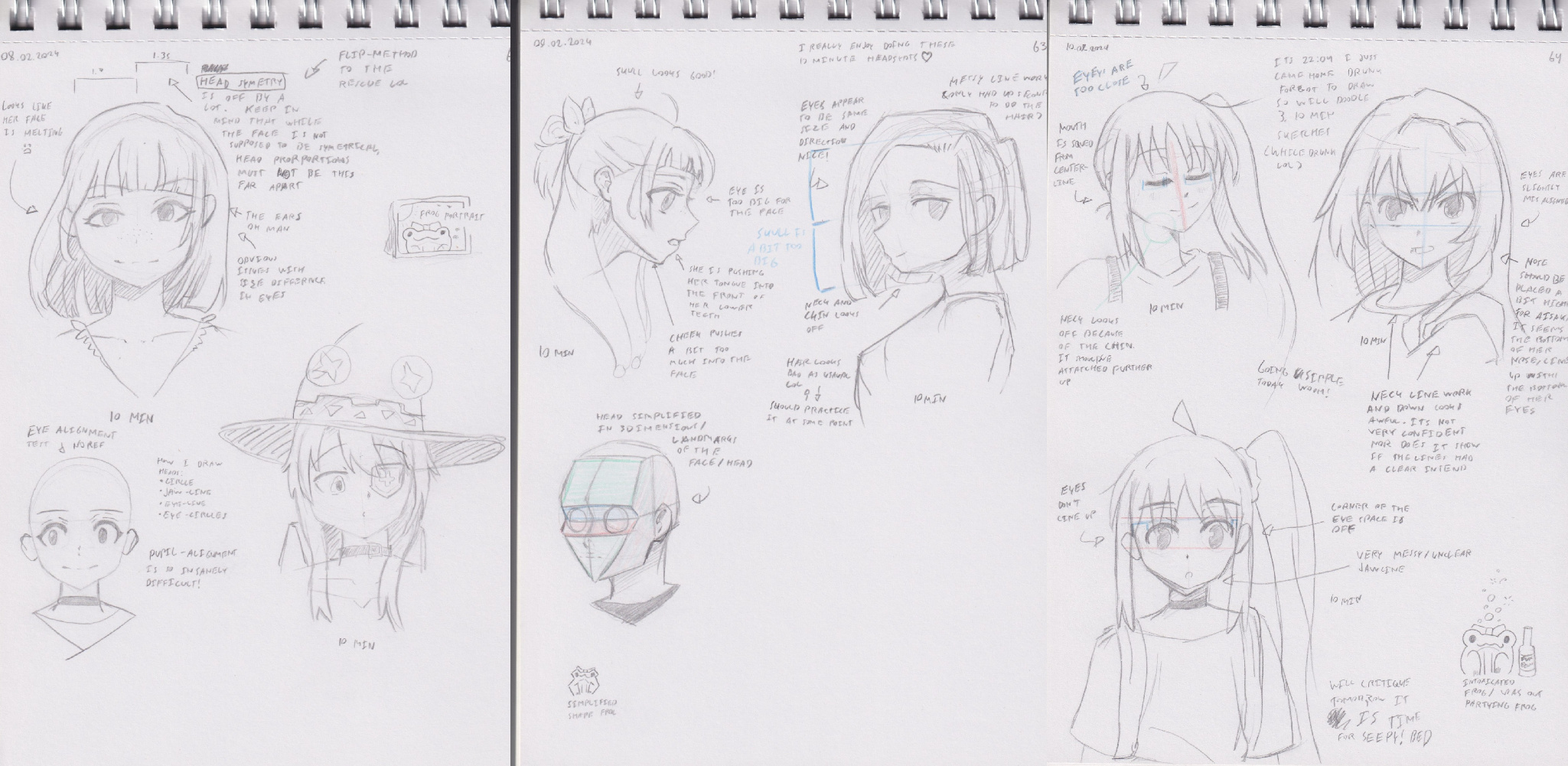
Day 61
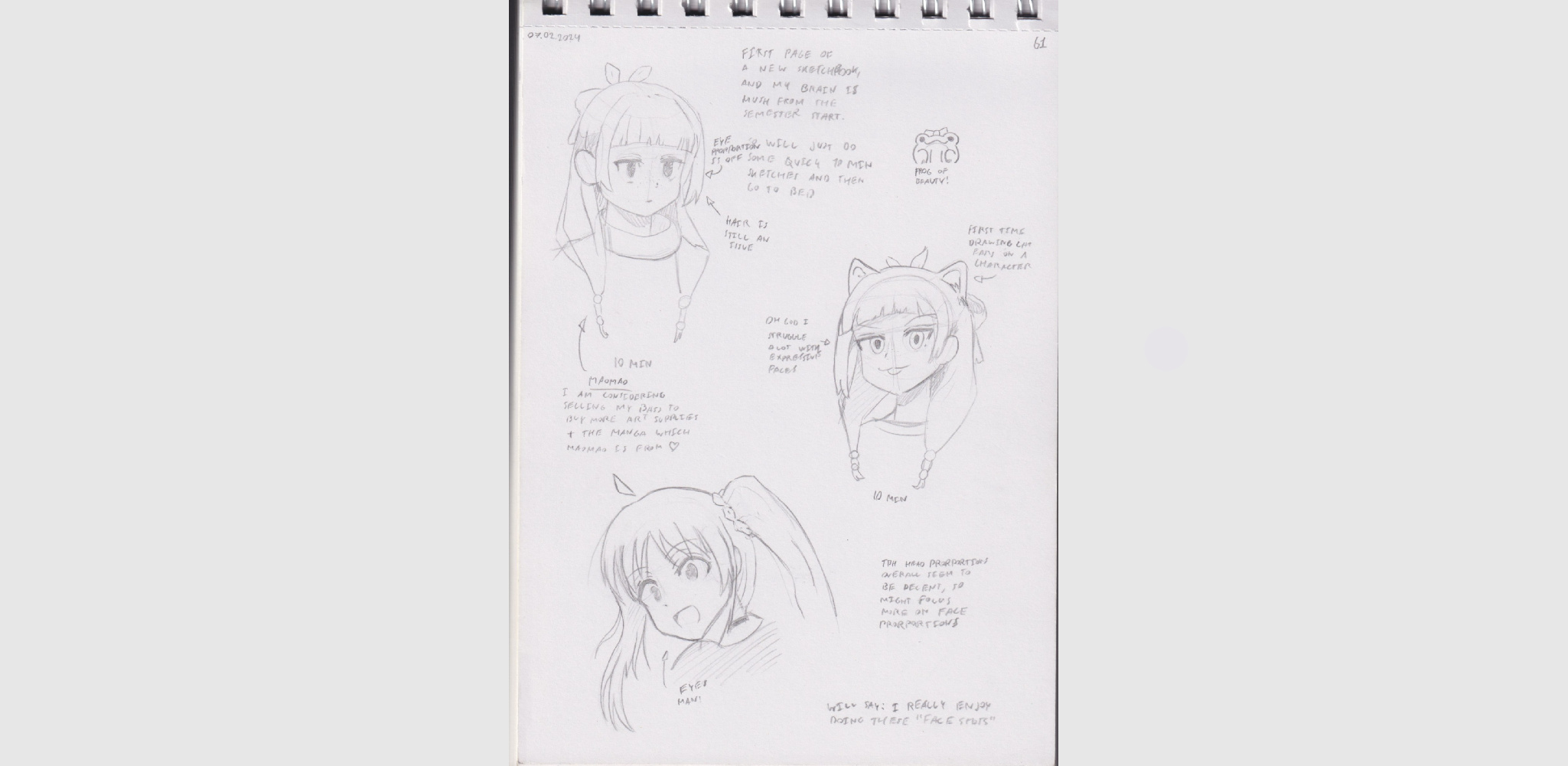
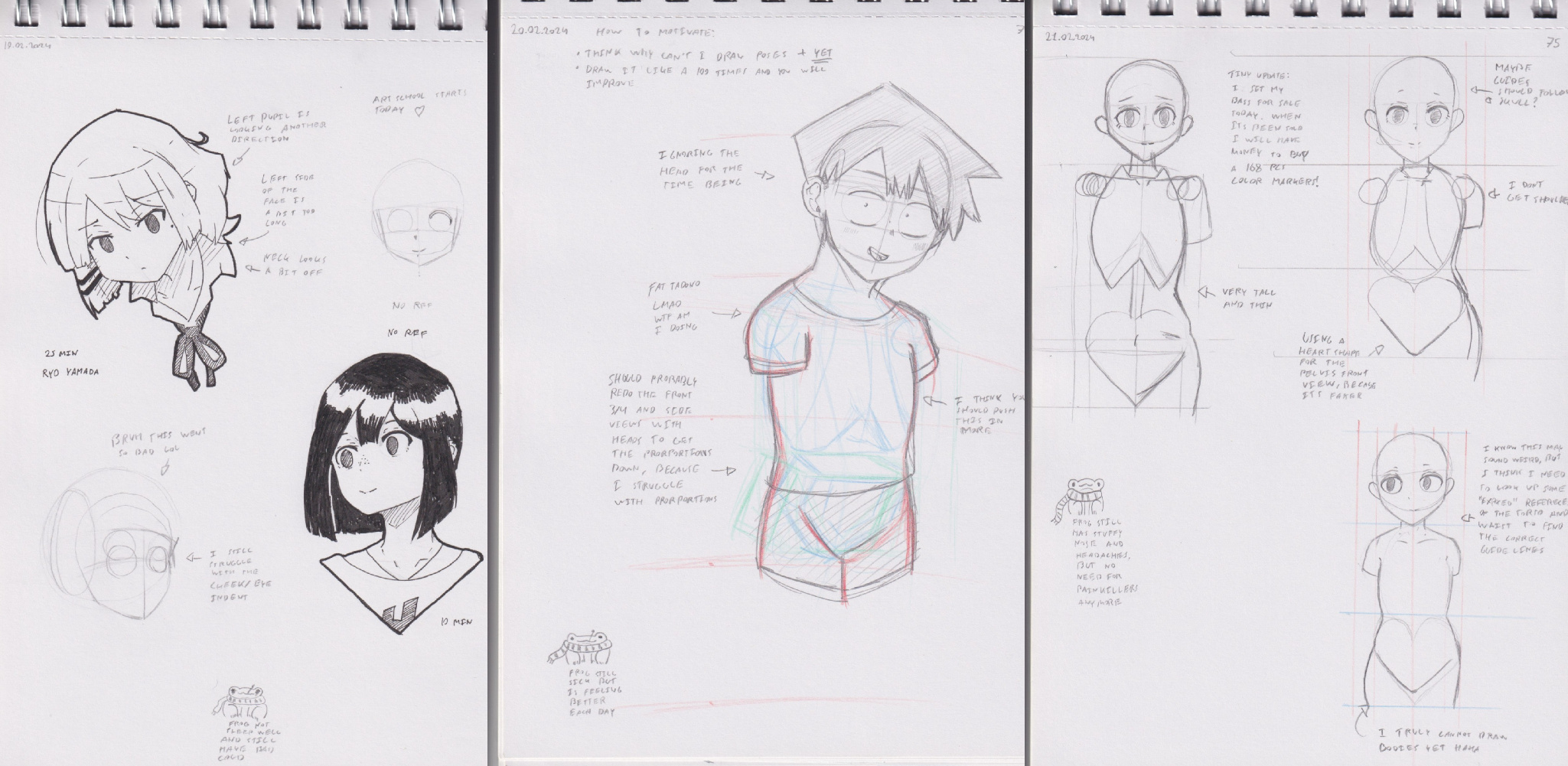
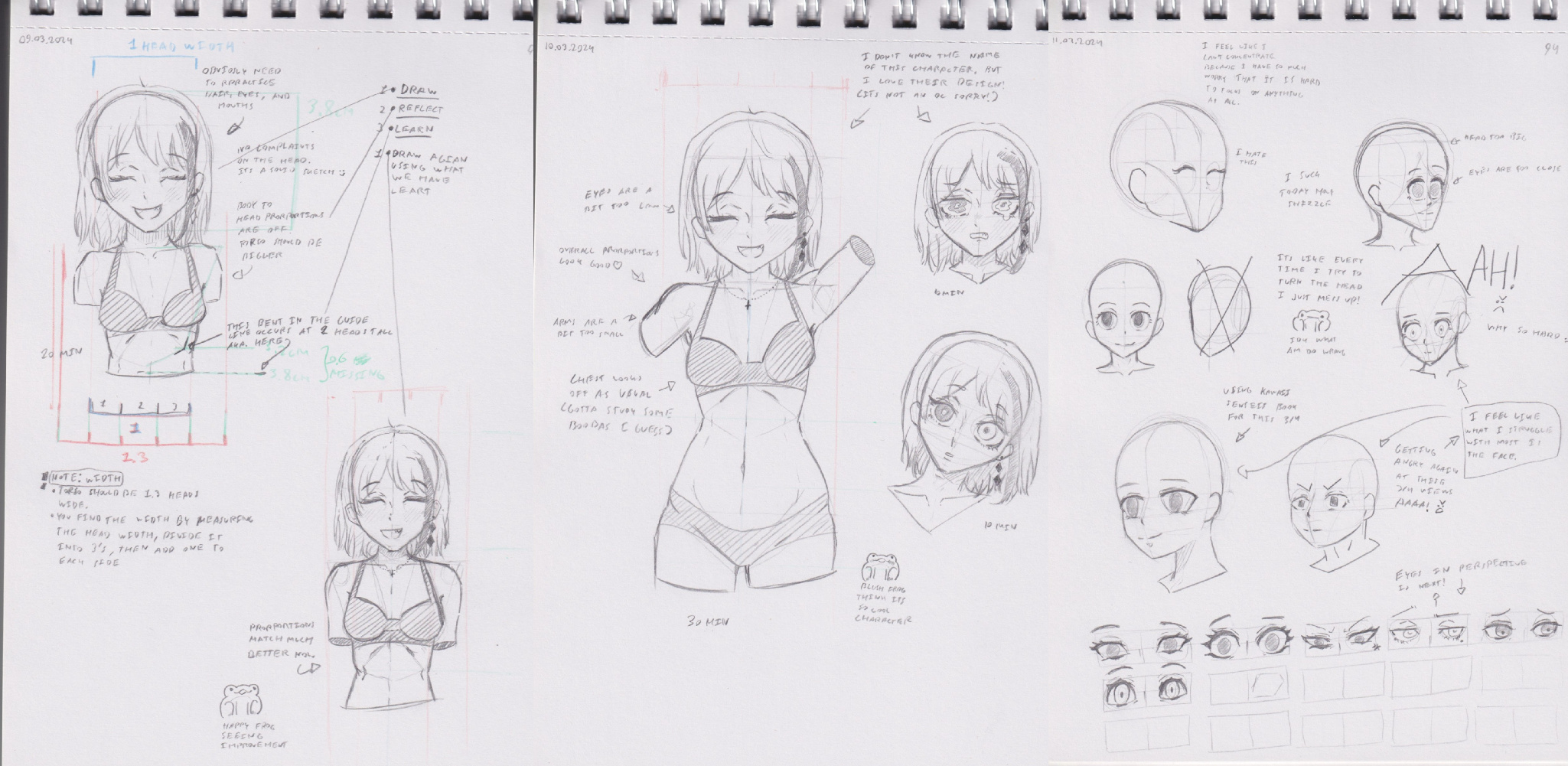
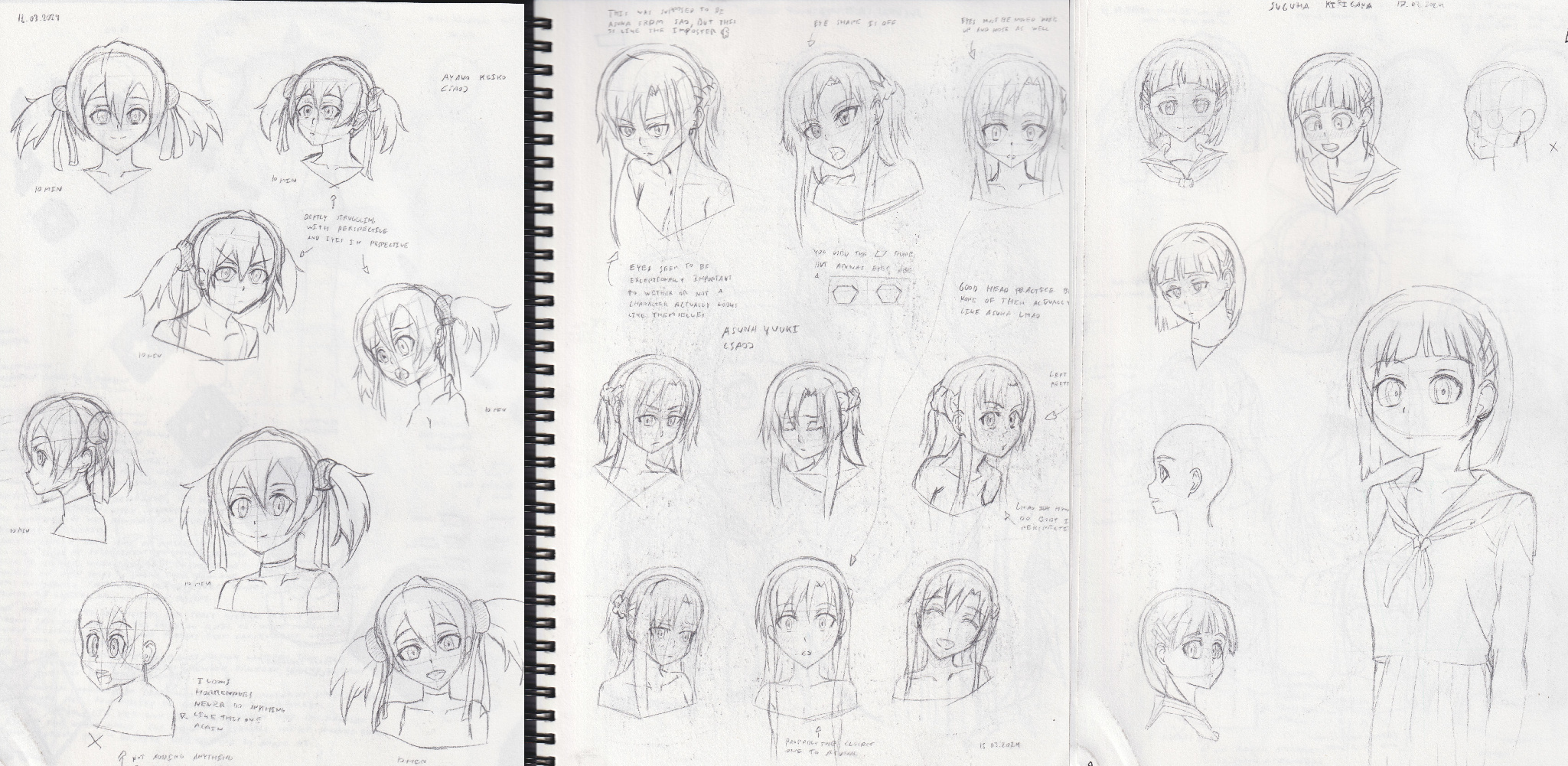
I started where I left off; studying heads. I realized today that I don't actually enjoy spending lots of time on a single drawing. Instead I find it more enjoyable to draw within a time frame. I sort of adapted the Draw → Reflect → Learn cycle, into Draw (for X minutes only) → Reflect → Learn. I find it to be quite helpful at the moment haha.
Day 62-64
I mainly spend these three days doing the same Draw (for X minutes only) → Reflect → Learn cycle, trying to notice if I was making any specific repeat errors. This is where I noticed that I have three specific tendencies:
1. I usually place the eyes too close to each other.
2. I misalign the eyes, meaning one is usually higher/lower than the other one.
3. I mess up the head-proportions, usually making one side of the face look 'swollen'
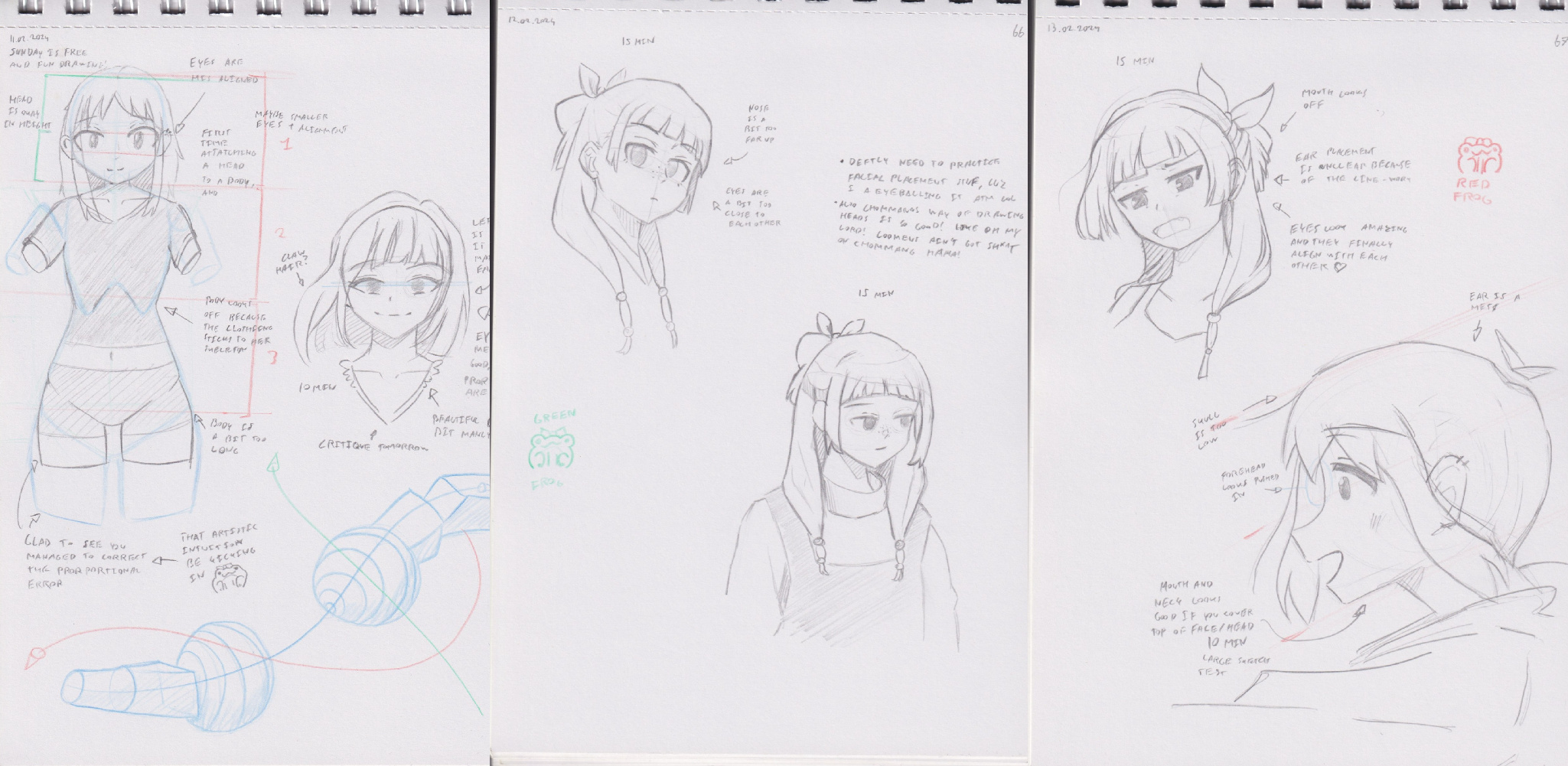
Day 65-67
Today I tried combining my head studies with my earlier torso/hip studies. There are heaps of mistakes, though I am very proud of myself, that I managed to notice the body to head ratio being way off in my inital sketch, and correcting it, even if my corrections still weren't perfect haha.
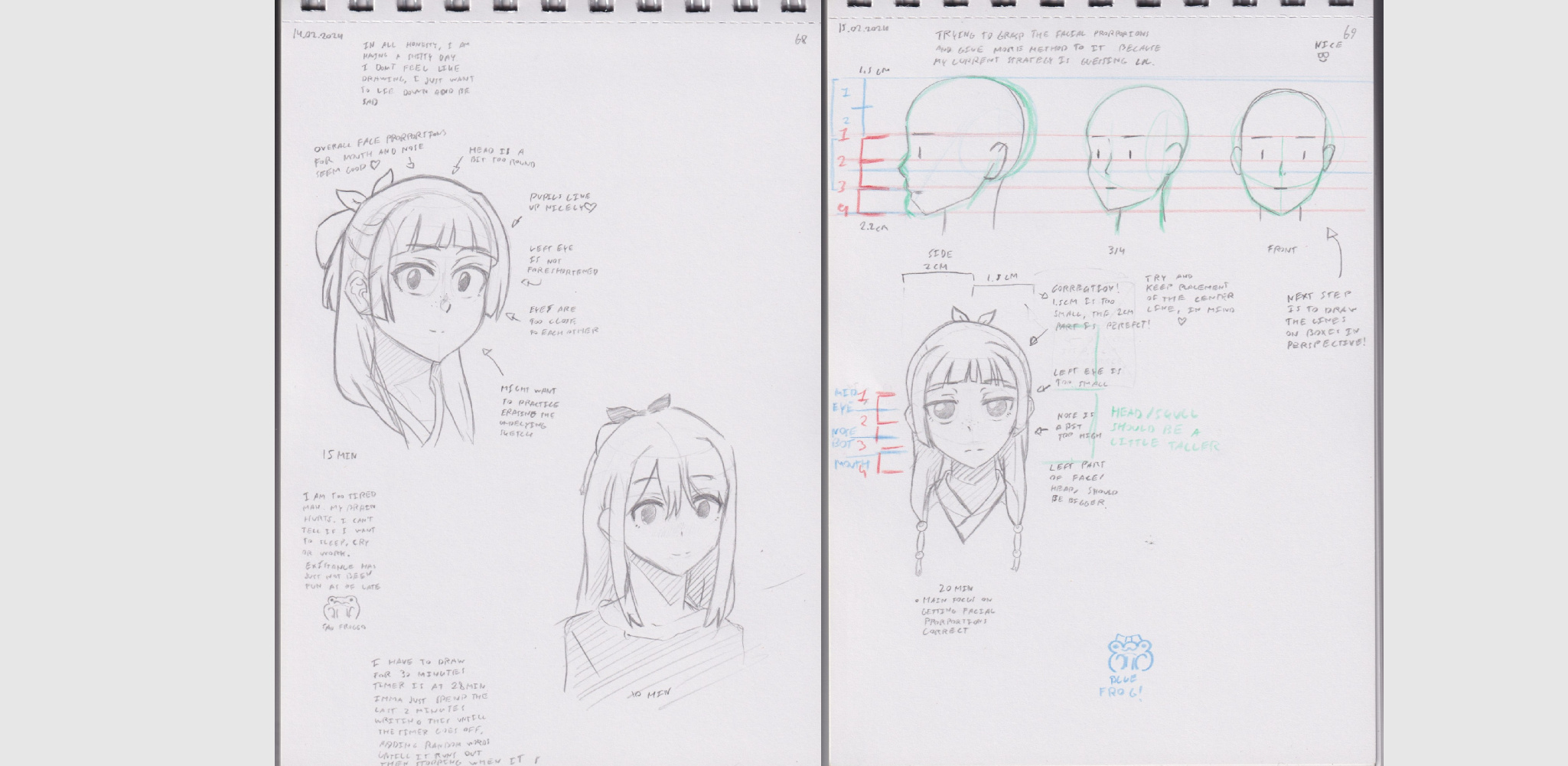
Day 68-69 (nice)
My main focus today is aligning the eyes, so that they are at the same height. The second thing (mainly on day 69 hehe) is that I am trying to nail down the landmarks of the face. I have specifically learned that the brow-line, tip of the nose, mouth and chin are the key landmarks that should stay somewhat consistent, regardless of other facial proportions.
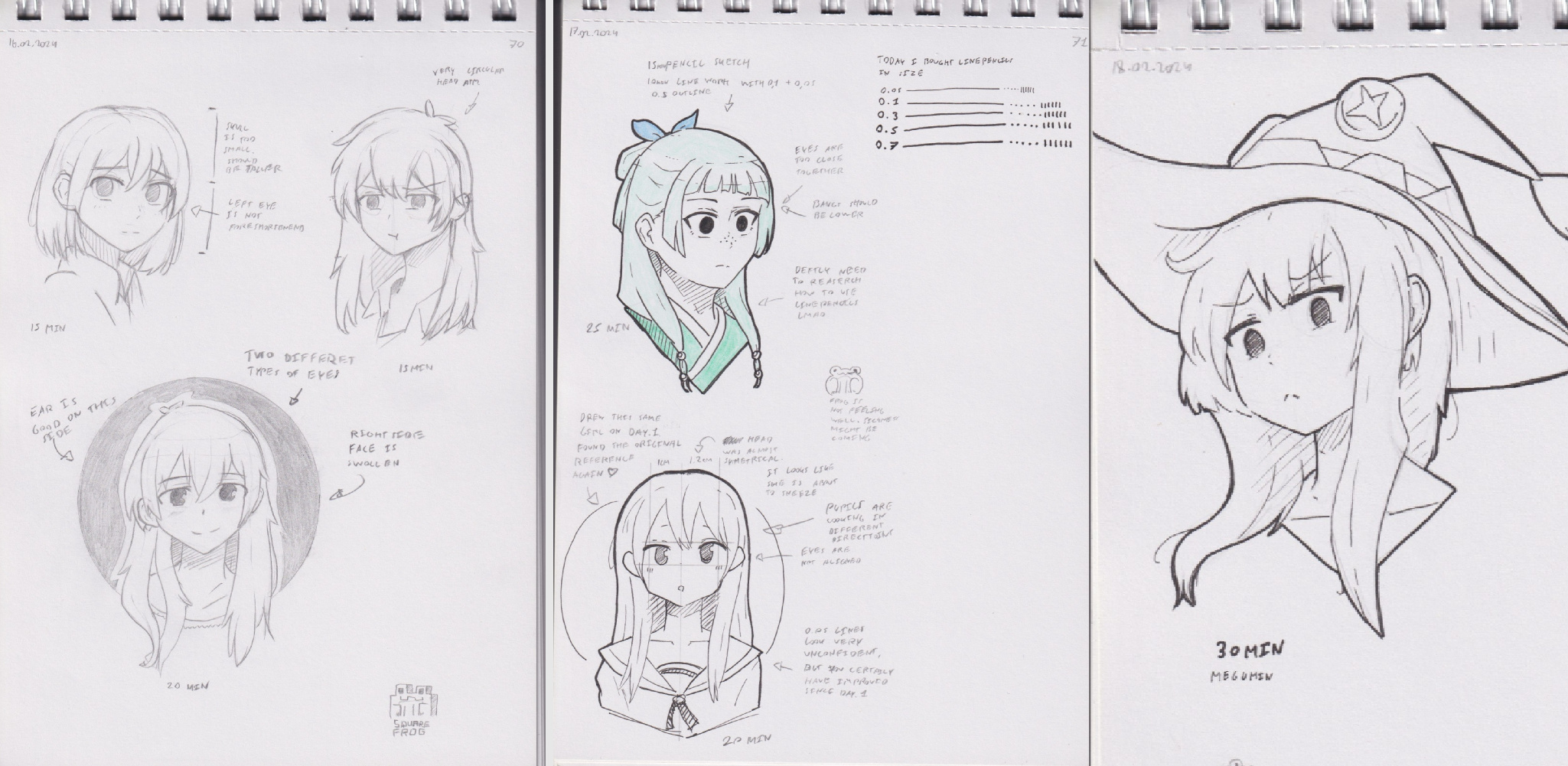
Day 70-72
Today I tried implementing the measurements from yesterday, using the landmarks of the face to get it right. Day. 71, I got a mail from the art-school saying to buy some extra art-supplies (fineliner pens), and an A4 sketchbook.
When I got home though, I began feeling ill, and day 72 I had to call in sick. Getting out of bed to draw on day 72 was honestly a nightmare, because I was running on painkillers and tea, so only spent 30 minutes drawing and then went to sleep the rest of the day.
Day 73-75
Today I am still not feeling well, but I really enjoy using the fineliners that I bought for art-school. This is also when I learned that one usually use the 0.05 fineliner for almost everything, and then add more volume to certain lines (such as the outline) with the 0.1, 0.3, 0.5 and 0.7 fineliners.
Part. 2 – Adding colors
Adding color and trying to match up the torso with head
Day 76
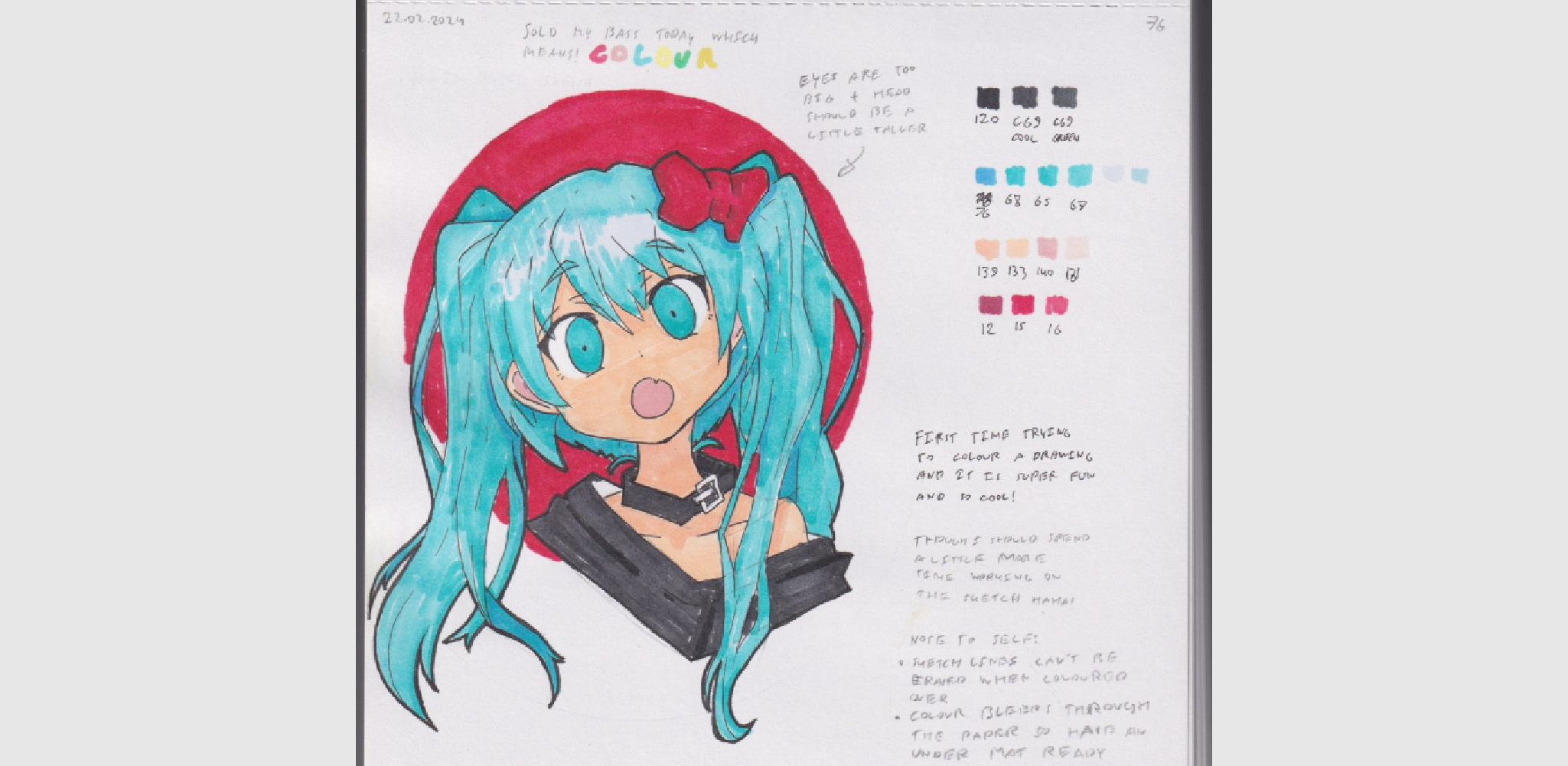
In my 'Future Goals' section from Sketchbook Journey pt. 1, I mentioned that I was contemplating selling my bass, and using the money from the bass to buy a 168pcs coloring set – and today I sold my bass, and went directly to the nearest art-supply store and bought the 168pcs set that I have been drooling over. So yeah, this is the first time that I have ever fully colored a drawing, and my oh my! I love adding colors!
Day 77-78
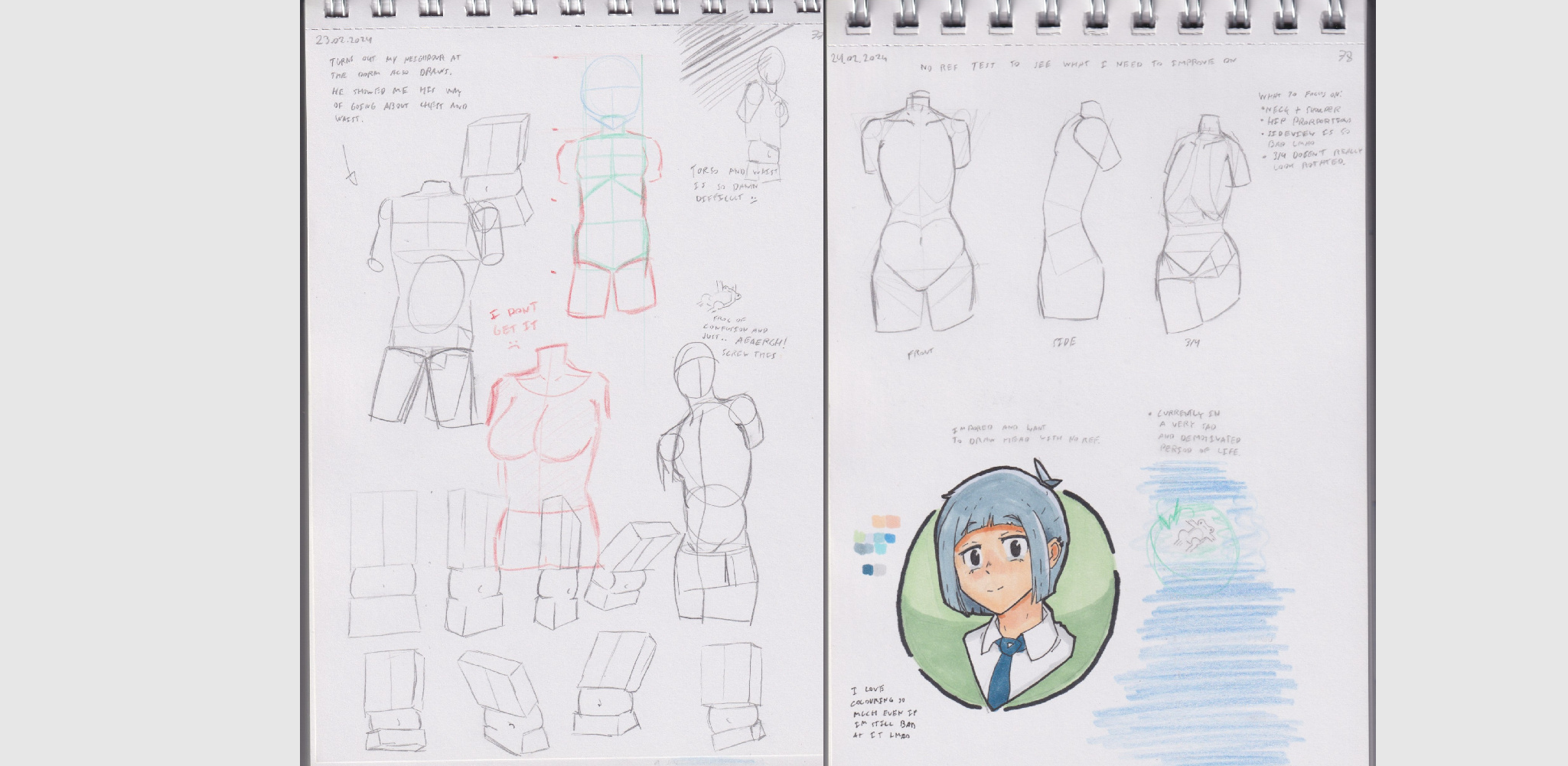
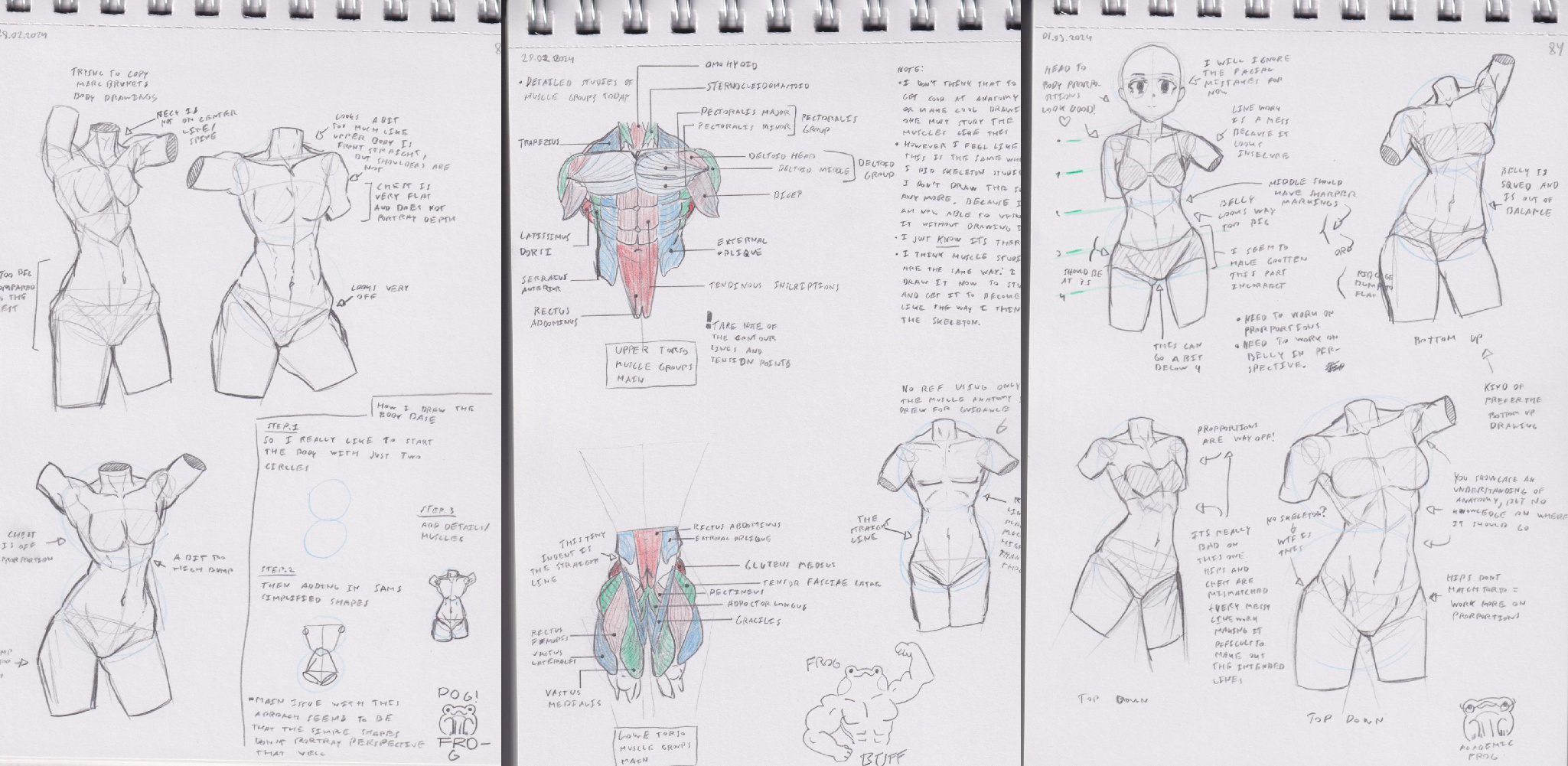
Today I dived back into my torso/hip studies, and learned from talking to someone else who is also drawing, that when especially when I am drawing the torso, I must always keep in mind, that the shoulders control most of the upper-body movement, while the hips control most of the lower body movement. This means that I need to be very aware of placing so-called "action lines" that indicate movement for shoulders and hips.
With that in mind, I tried drawing the torso and hip from memory, only to realize that I only know the skeleton, but have yet to think about the muscles that also give the human body its shape. With inspiration from Marc Brunets 7-day practice cycle, I adapted his practice cycle to what I've learned from watching Oridays Draw → Reflect → Learn cycle and made the following 7-day cycle, for learning anatomy.
Day 79-81
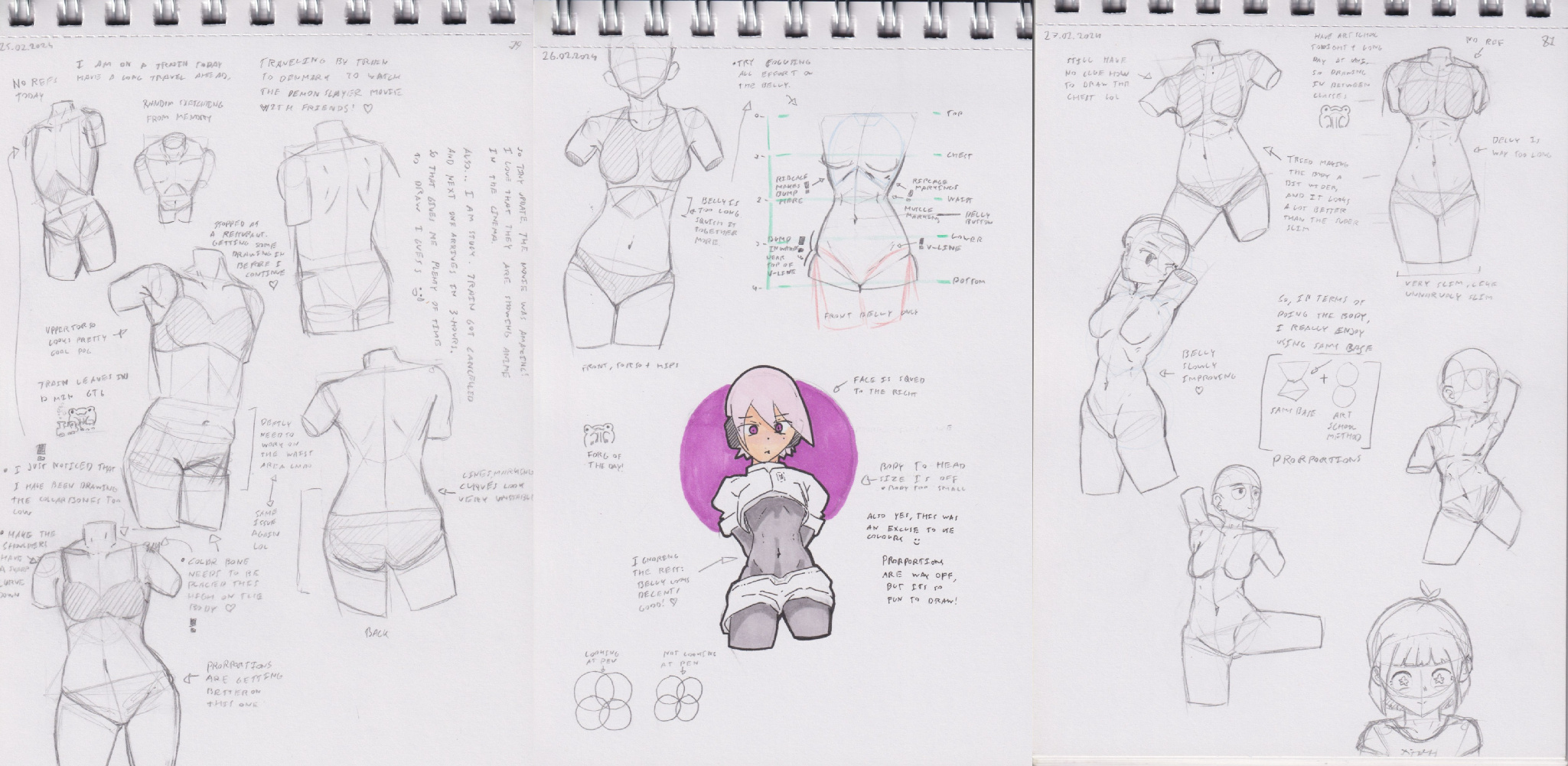
I realized that while I am able to get majority of the outer-shapes somewhat correct, one thing I have no understanding of is the belly. So re-using my knowledge on looking for landmarks in the face, I applied the same idea to finding landmarks on the belly to help me understand, and more consistently draw the belly. I also learned, that I prefer SamDoesArts approach to anatomy, in favor of using boxes (see day. 7-12)
Day 82-84
Today I did an artist study of Marc Brunets way of doing anatomy. Today is also when I started applying one of the principles that I was taught at art-school, which is to use circles of the same size, in order to keep proportions of the body to be consistent throughout the entire drawing. I even drew a little explainer on day 82, in the right corner.
Day 83, I did a detailed study of the muscles and muscle-groups of the torso and hip. I want to note that I feel like doing such detailed muscle studies, is sort of like when I did skeleton studies on day 41-51: I won't visibly be drawing each and every muscles group as detailed or refined as here, but because I've done this study, I now subconsciously will be able to spot if for example the trapezius is missing or not defined enough.
Are detailed muscle studies necessary to become a good artist? (discussing art-style):
– From my own experience, I would say that it depends on what you goal is. If drawing characters is a hobby and there is no intention of doing paid work, then I would say no; draw what you enjoy and have fun with it. However, I will say that I think it is necessary to do muscle studies if the goal is to one day do paid work or dynamic/consistent full-body characters.
– I personally think that before an artist can truly break out of a box and find ones own art-style, one first needs to learn where the walls of the already established 'box' is, and how one can get to these walls. If an artist claims to have 'broken loose' from established principles without understanding or acknowledging them first, it seems kind of disrespectful to others who have invested significant time and effort into perfecting their craft.
– I don't think an artist can create amazing or stunning art, if they only rely on one approach alone. I think that emotion in and of itself is a box that can be broken by method, and method is a box that can be broken by emotion – but neither emotion nor method, seems able to find each others walls, unless they've learned from each other – Thus if they don't learn from each other, they can't break each other.
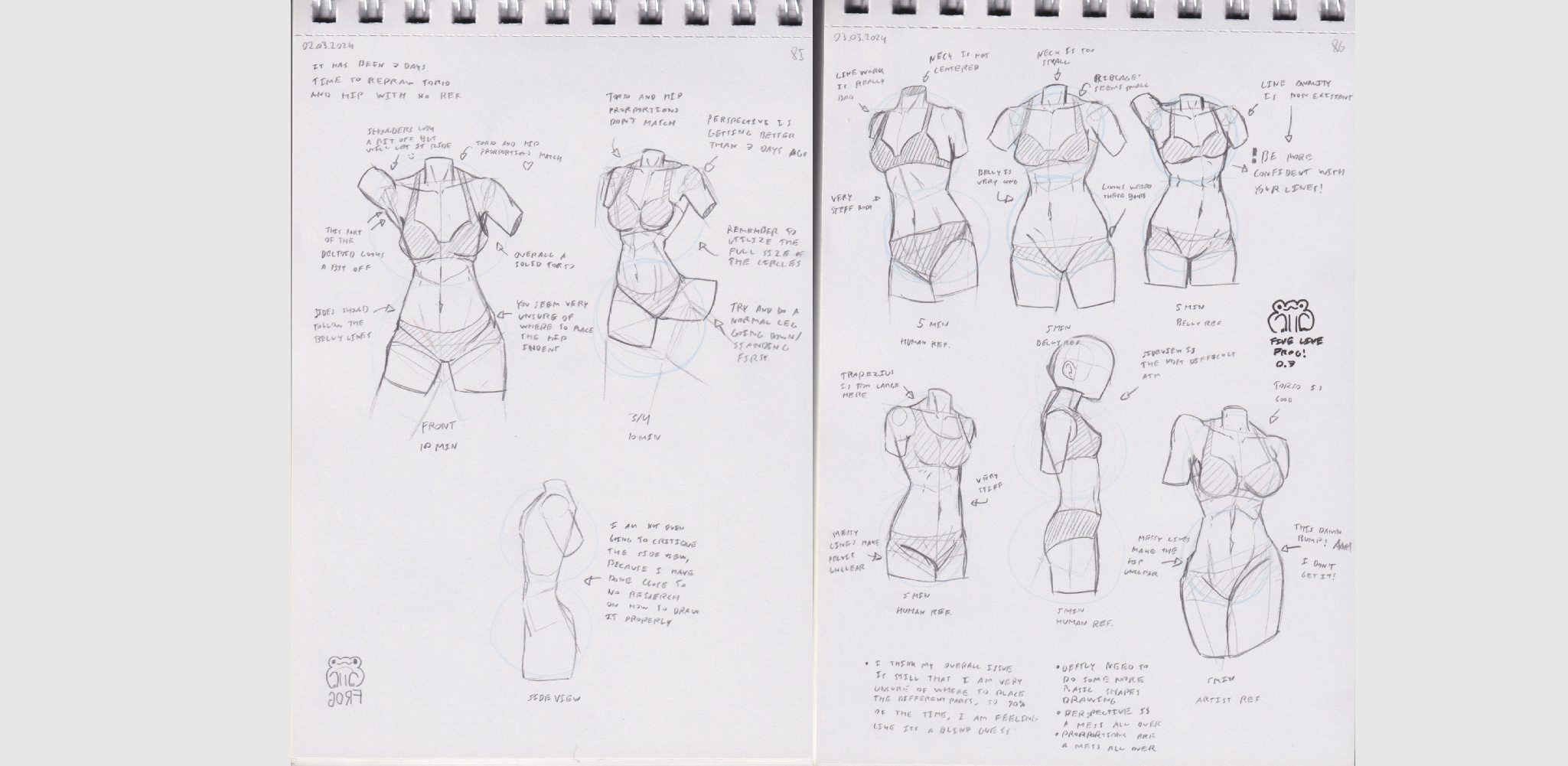
Day 85-86
Today is the end of the first 7-day learning cycle, and I have deftly improved on my front view! Side-views and 3/4, I will have to come back to study those as well.
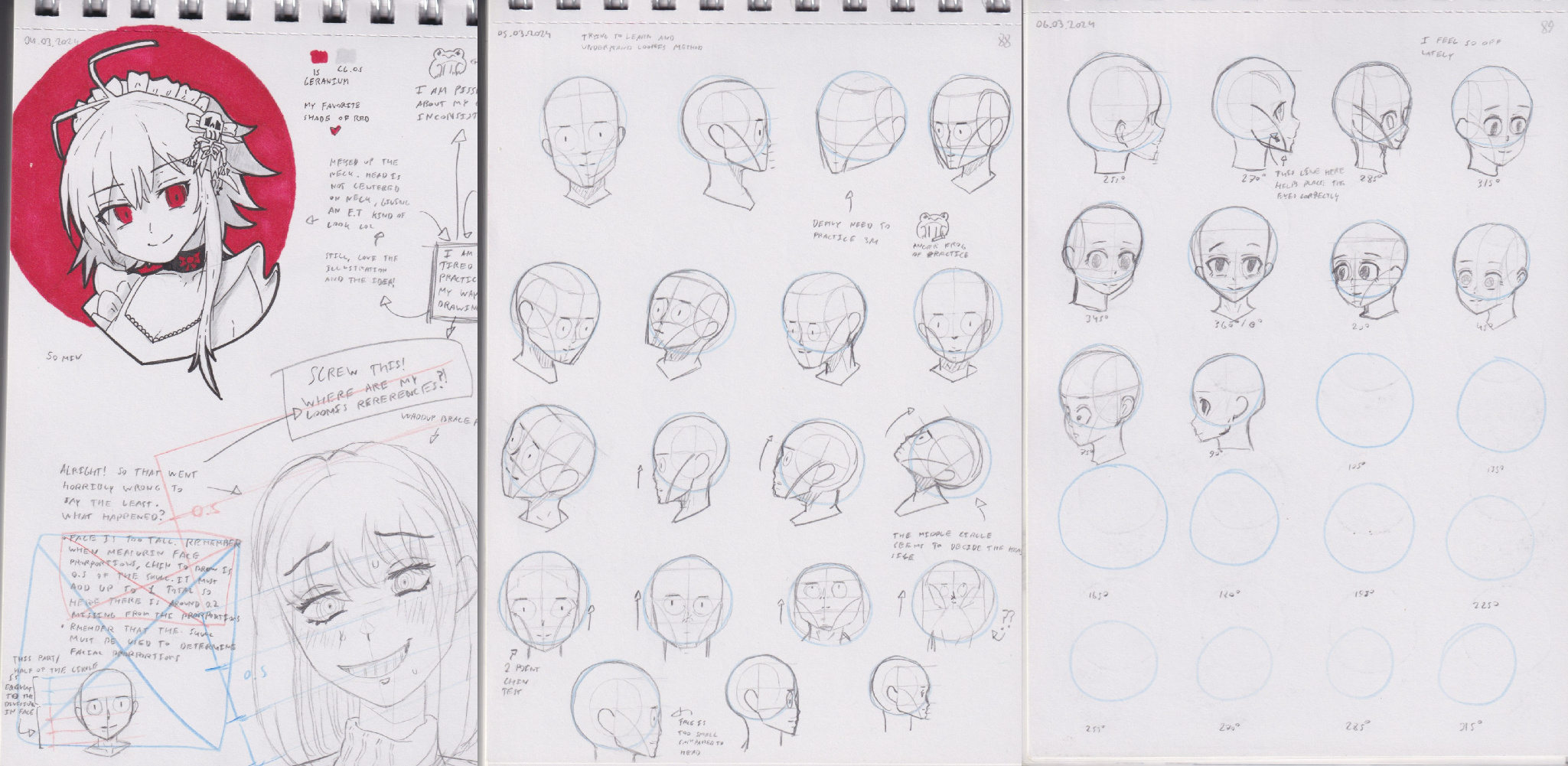
Day 87-89
Today was a very emotional day, as I got extremely angry at my own inconsistency, and that the landmarks I had been using for the face, turned out to be very inconsistent and unreliable. I ended up asking the art-help Discord community, and luckily, they introduced me to Loomis method, and jokingly said "Now draw 10.000.000 heads!" – which I partially took literally, and spent 2 days just doing Loomis method.
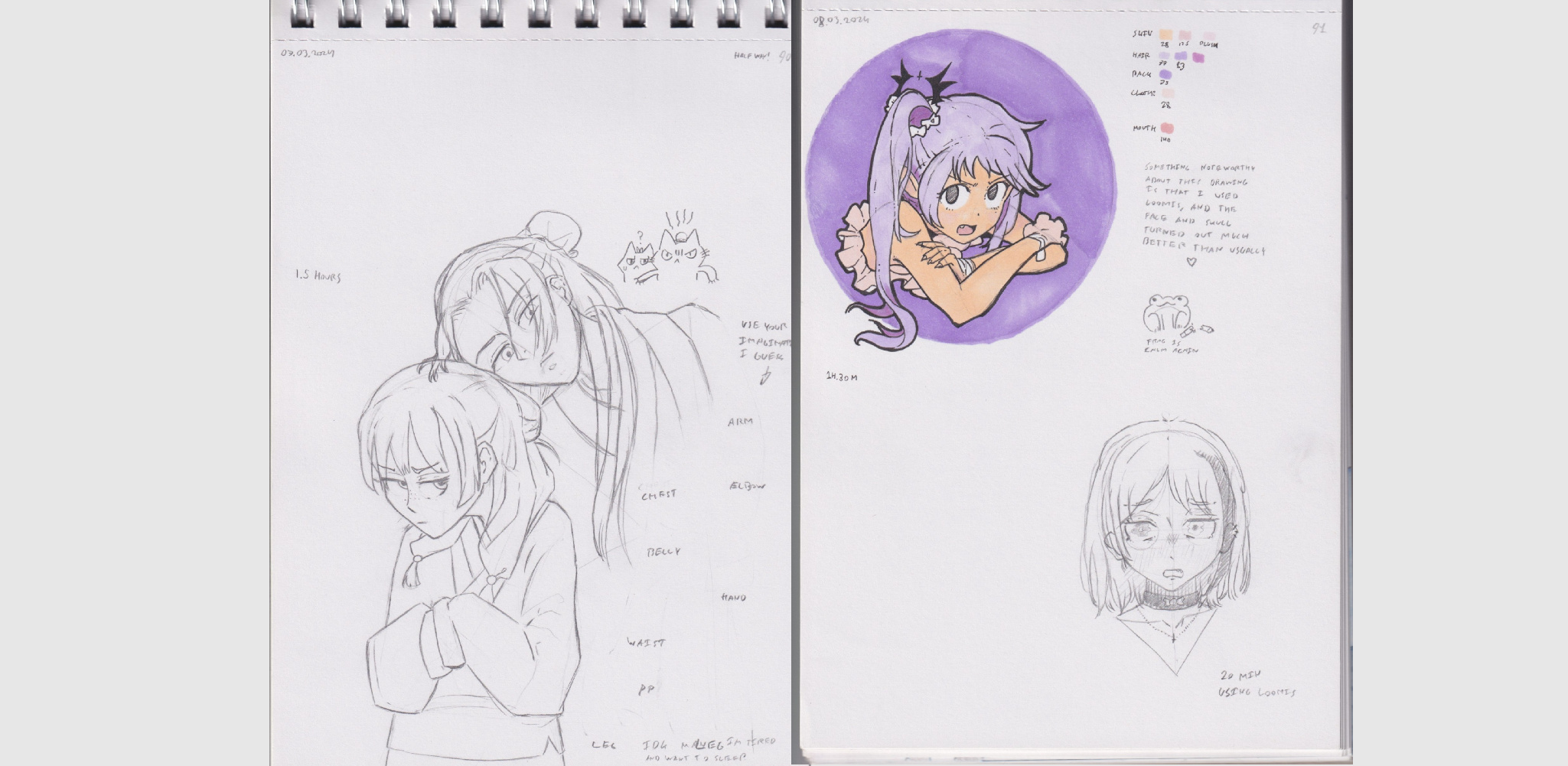
Day 90-91
Today is the half-way mark for Sketchbook Journey II, and so I decided to try and do a full piece, and use the Loomis method in a full piece for the first time. While facial and body proportions are very janky, I will say, that I overall feel a good improvement, using the Loomis method as a more reliable and consistent way of drawing heads.
Day 92-94
Today I again tried to combine my head studies with my torso and hip studies, and I will admit, that my drawings on day 92, and my absolute favorites because they are so proportionally well-balanced. And day 94, was the complete opposite of day 92, as I did not have a very good day drawing.
Part. 3 – Legs and faces
Adding color and trying to match up the torso with head
Day 95-97
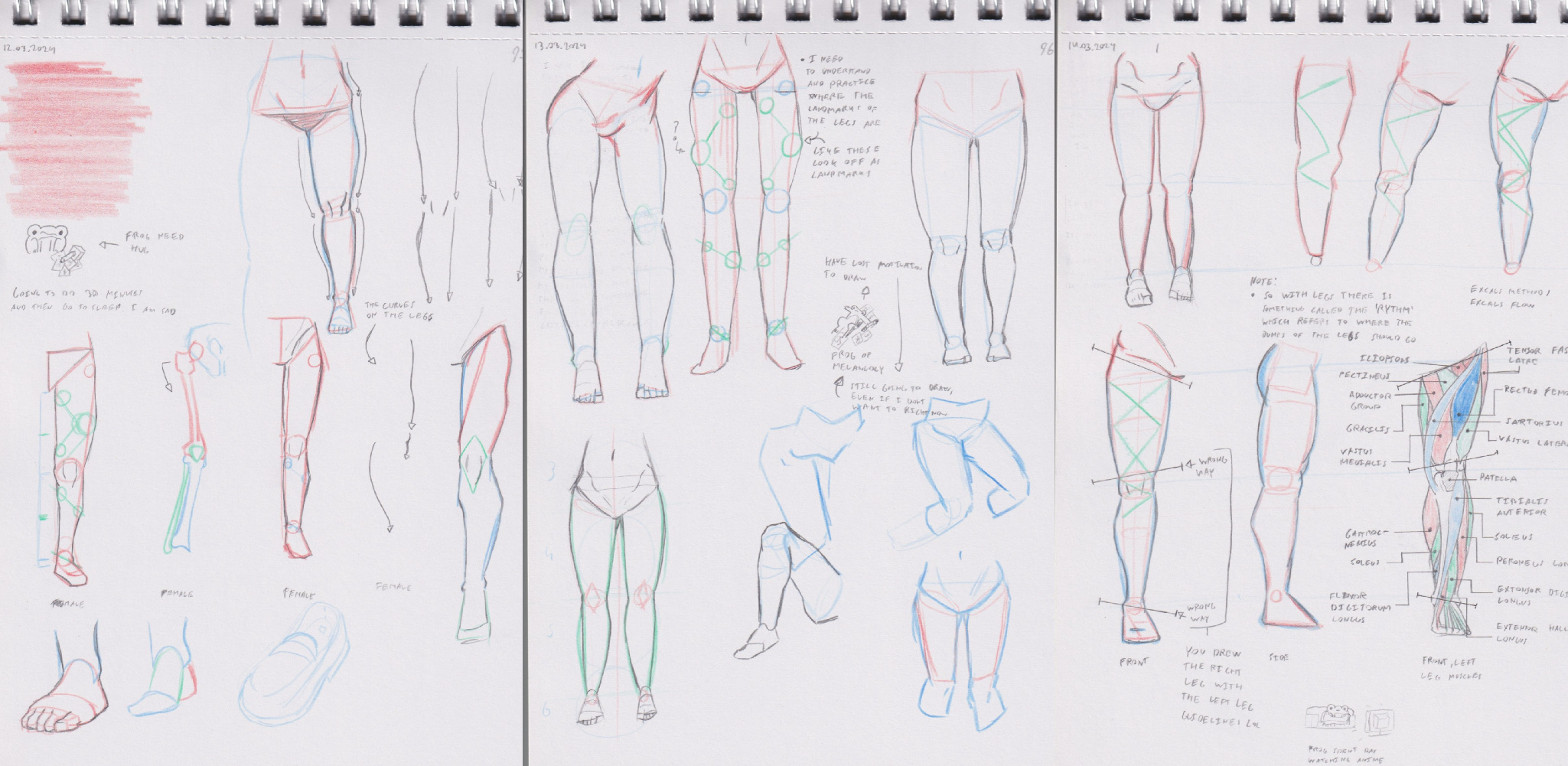
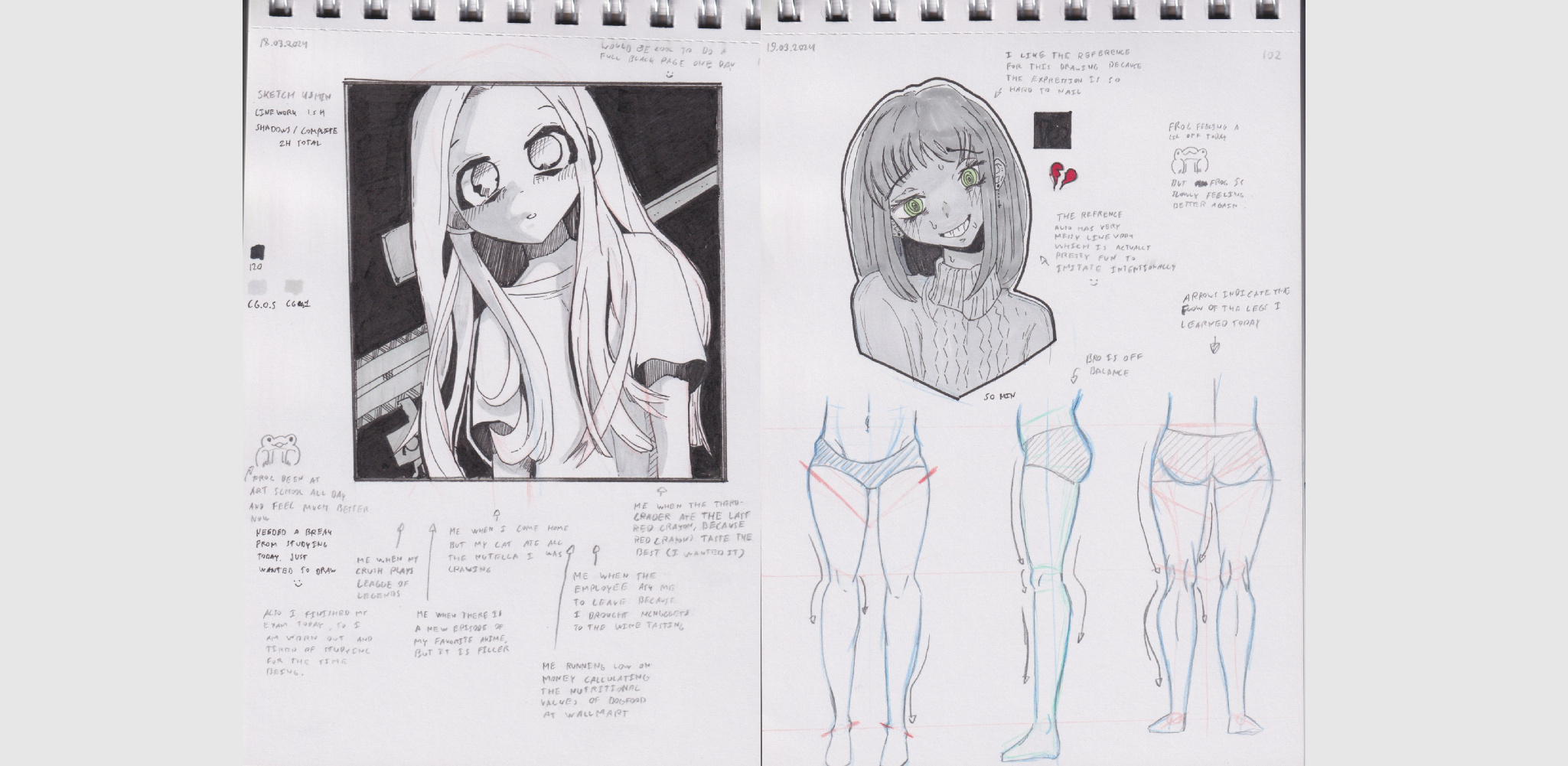
Today I started doing leg studies, mainly trying to learn the basics of drawing the legs. I learned that there are two main things to pay a lot of attention to when one is drawing legs:
– The flow / rhythm of the leg (as shown by the arrows)
– The balance points of the legs (does the leg look balanced, or does it have an unnatural tilt)
BONUS – Meet my new OC, Cherna
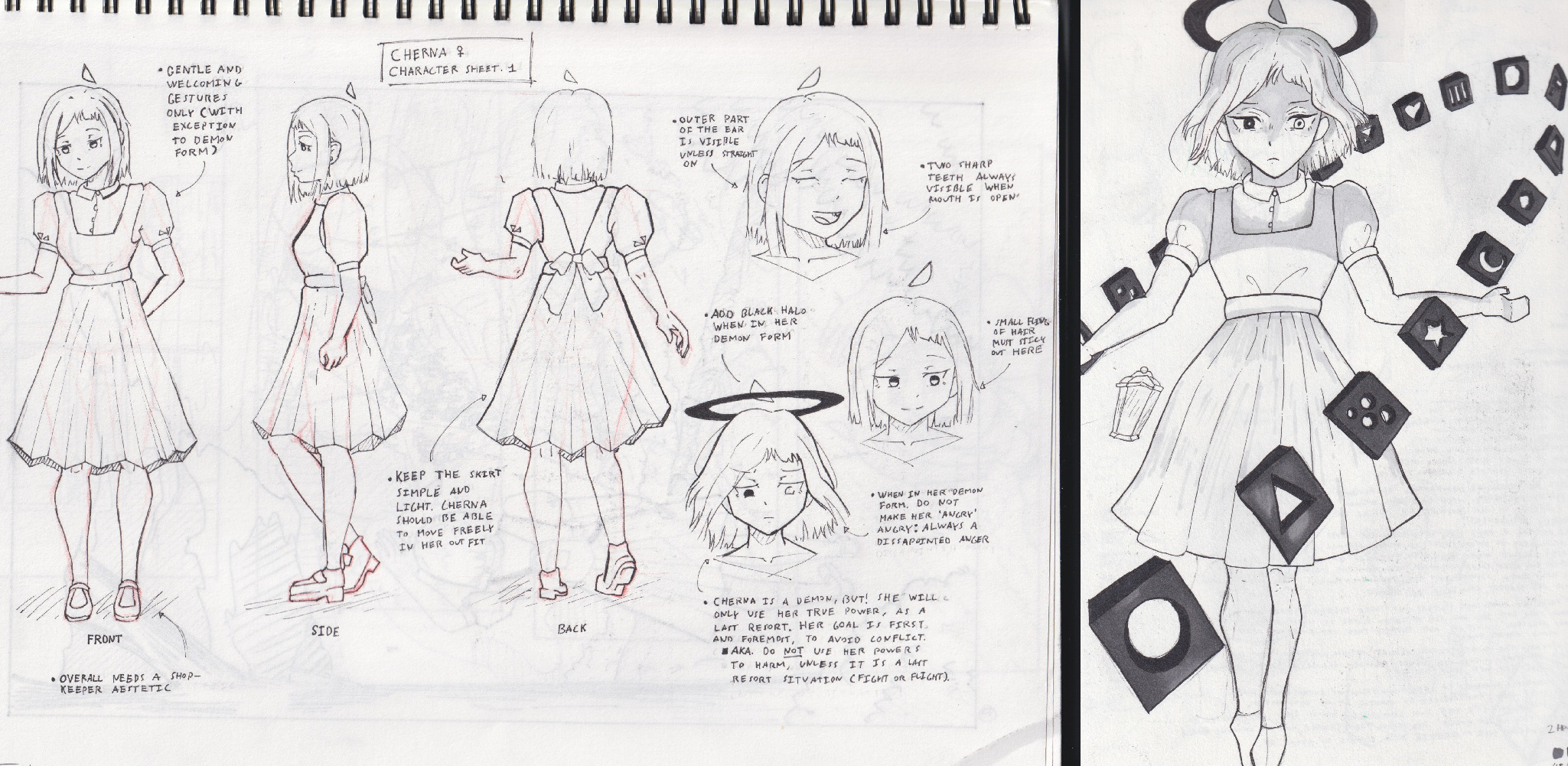
Today is 95, and I am super excited to introduce my very first OC (kinda)! Technically one could argue that my first OC is the blue haired girl from day. 42, but this is the first time that I have made an OC with a personality, backstory, world and name!
So without further adieu: Meet Cherna!
(Thank you so much Fawne for the name suggestion. I love the reference so much!)
– Cherna is an excitable, optimistic, and deeply passionate individual, particularly when it comes to the world of literature. She presents herself as approachable and unassuming, often donning a simple dress paired with a modest shirt beneath, eschewing makeup.
– Despite her tranquil demeanor, Cherna harbors an intense curiosity, often venturing beyond the confines of her bookshop in pursuit of rumored discoveries.
– While possessing a strong sense of justice, she tends to steer clear of entanglements in others' dramatic affairs. However, when faced with injustice or adversity, Cherna often tries to correct it from the shadows, only reluctantly tapping into her demonic powers, using the obsidian plates she carries, only as the last resort.
– Her abilities afford her mastery over three eternal flames and the shadows they cast. The flames and shadows are linked, meaning that if all three flames are extinguished – Cherna will permanently lose all of her powers. Therefore she conceals these flames within lanterns scattered throughout her bookshop, using them to light up her bookshop, so that her powers remain discreet, leaving visitors not to question her true nature.
– Cherna uses the obsidian plates to shape the shadows, creating either illusions or shadow puppets that can interact with the world around them.
– Cherna has a practical approach to life, honed from her experiences evading trouble, underlining her adaptability to survive in any environment. Yet, as the only demon (to her own knowledge) that has managed to escape the underworld, Cherna finds that trouble has an uncanny knack for finding her, despite her efforts to avoid it.
Day 98-99
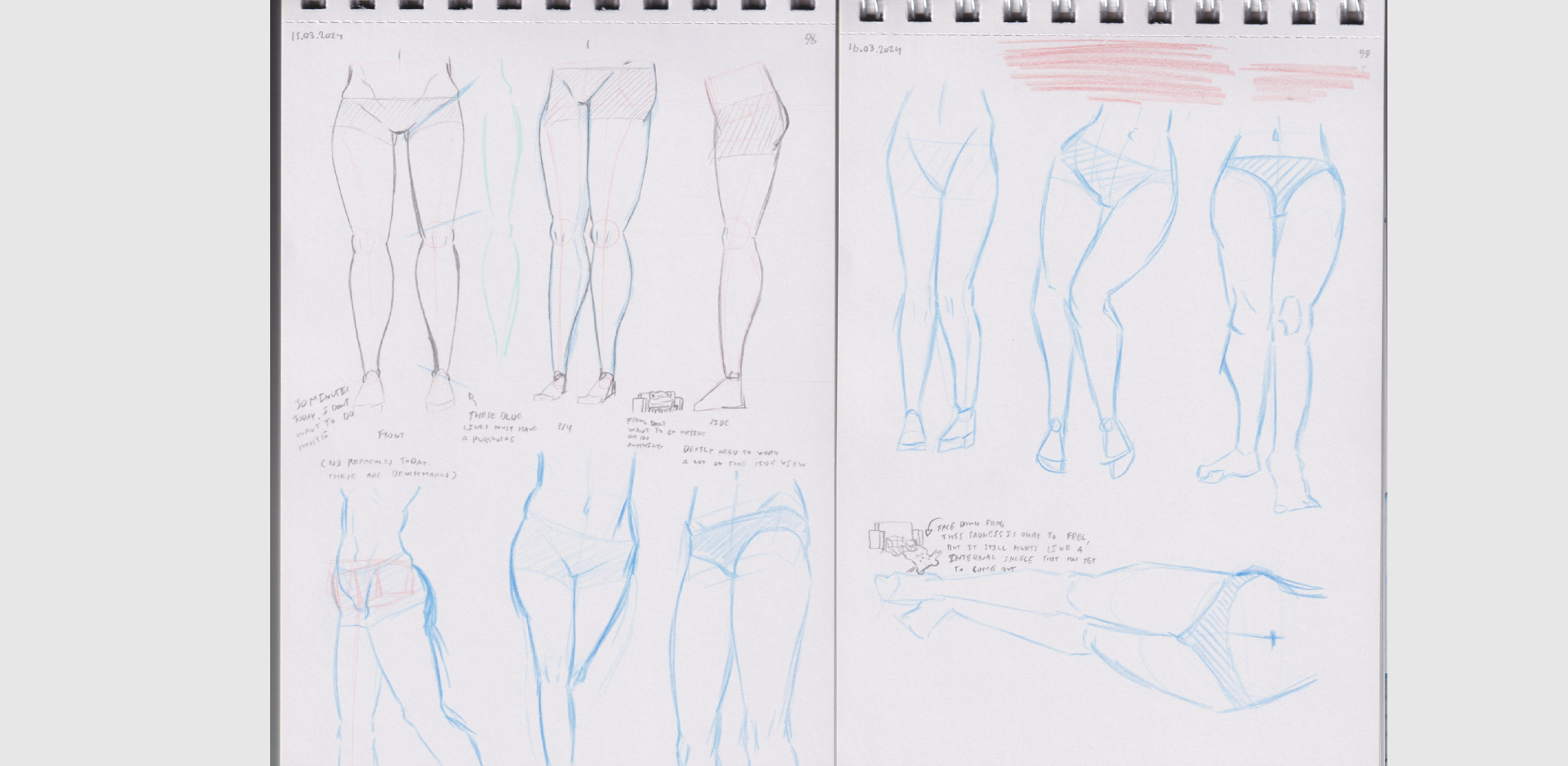
Today I did more leg studies, however, without going into too much detail, my mood has been starting to decline by quite a bit. This also means that I've only been spending the required 30 minutes drawing, and then mainly just been binge-watching anime.
BONUS – Settei Dreams resource
I made a pretty amazing discovery during this time as well. I've had issues when using Pinteres, that stuff like expression sheets or proportion sheets for characters from different anime, is usually not consistent in the references on Pinterest. But! It turns out that there exists a dedicated website called Settei Dreams that has scans of the sketches and animation-guide sheets, that were used by the actual animators!
I've been using Settei Dreams to find and practice consistency in my proportions and have been drawing expression sheets when I wake up and have a bit of time to spent before I have to attend morning lectures.
Day 100!
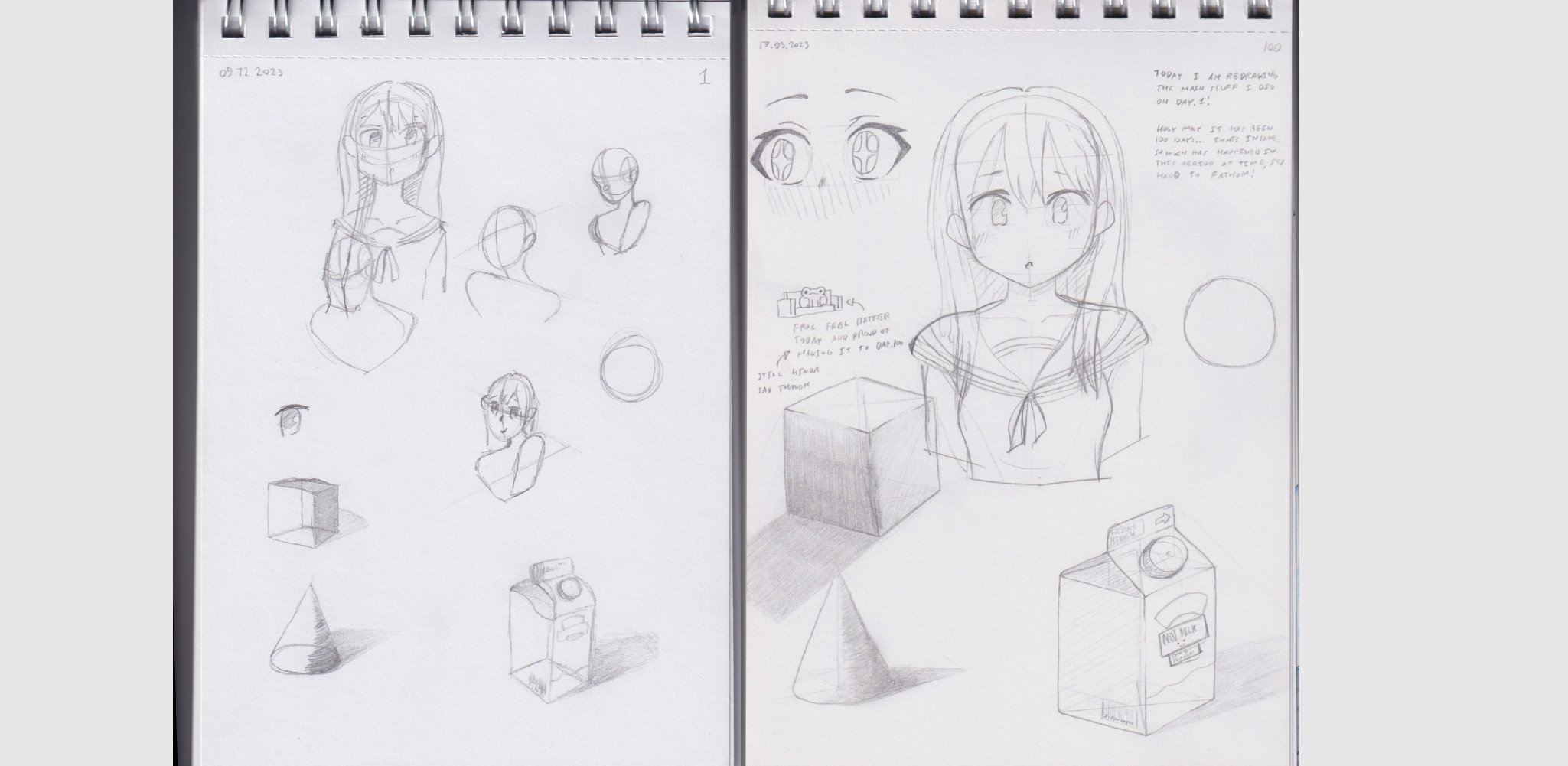
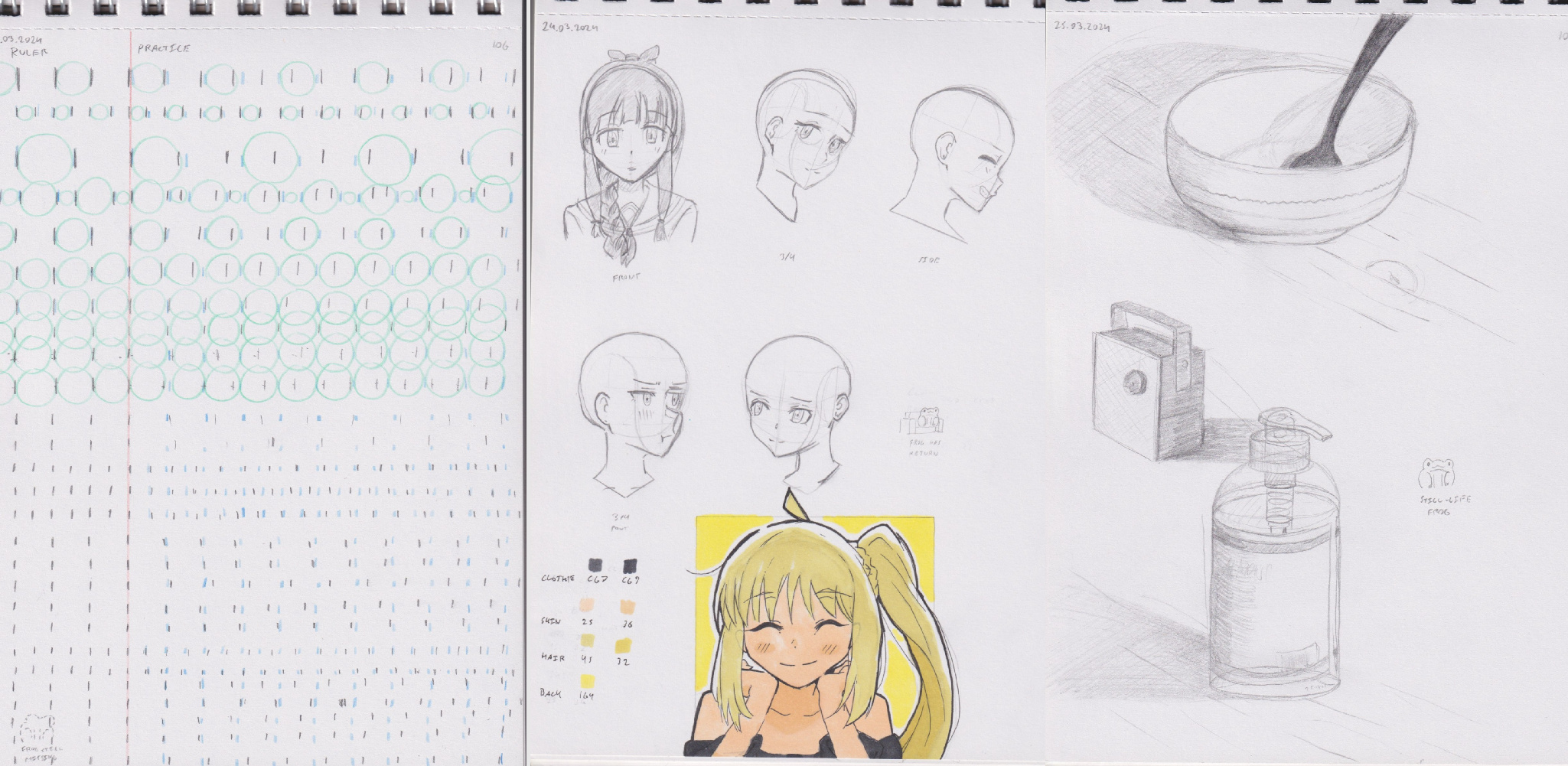
Today is a very special day, because it is day 100! It is so fun to redraw my day. 1 drawings again, and see that I have actually improved quite a lot! The main thing I notice is that since day. 1, I now approach drawing faces, shapes and objects much more methodically than I did on day. 1, where I was basically just guessing and trying to copy what I saw.
I still do a lot of chicken scratching when drawing, but I've noticed that it only really happens with clothing and parts of a drawing that I am unsure about, so as I keep studying (and eventually get to study clothing), my line quality should slowly but surely improve as I gain more confidence in my abilities.
Day 101-102
Today I spent most of my time attending art-school where I ended up making two drawings that I am super proud of. One is a reference I found on Pinterest, and the other is a panel from the manga Ima Koi (It's a good read!). Day 102, I did some quick leg studies, but tbh, my mood has not improved since day 98.
Day 103-105
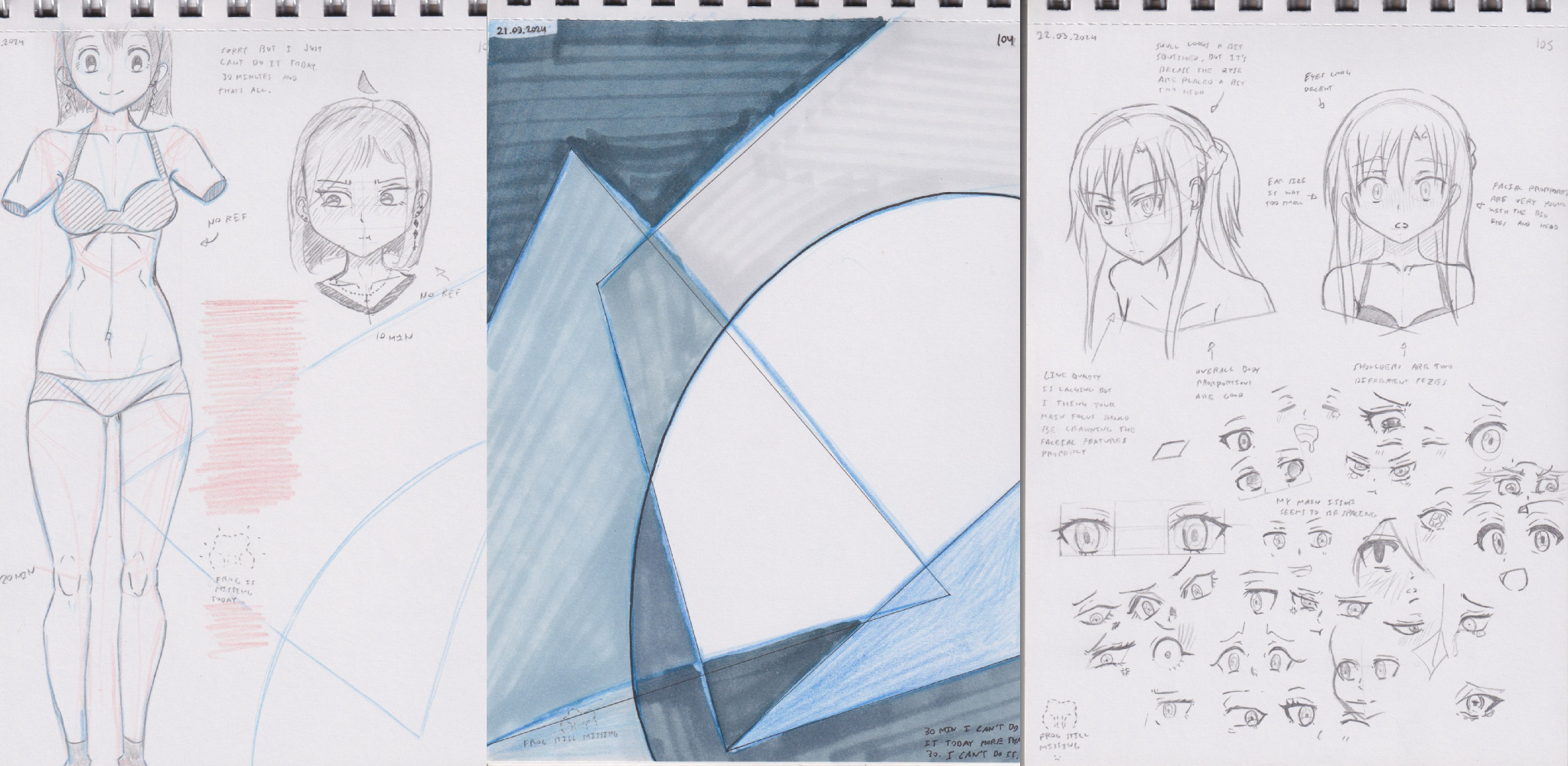
My mood has been declining even more, and I will be honest and say I don't feel well. My mood has started to affect my drawings as well, as I have not been able to continue my leg studies for some time now. While I do intend on getting back to the studies, for the time being, I need to take a quick break from dedicated drawing, and just draw and practice what I want to.
Day 106-108
These days I am taking a break from studying, and more so just drawing what I want to and what I can manage. It's a little annoying that my mood has affected my drawing this much atm, but – without going into detail – I feel that my current irl situation calls for immediate attention, and cannot be taken lightly. Please note that you (the reader) does not need to worry. I have irl friends and people that I talk to and whom support me through this, so you don't need to worry about me :)
Something that may require a quick explanation though is my "drawing" on day 106. I noticed on day 105 that my spacing is very inconsistent, so on day 106, I tried to create a spacing-practice-sheet. Wether or not it works, only the future will tell, but I find it relaxing to just do something simple.
Day 109-110
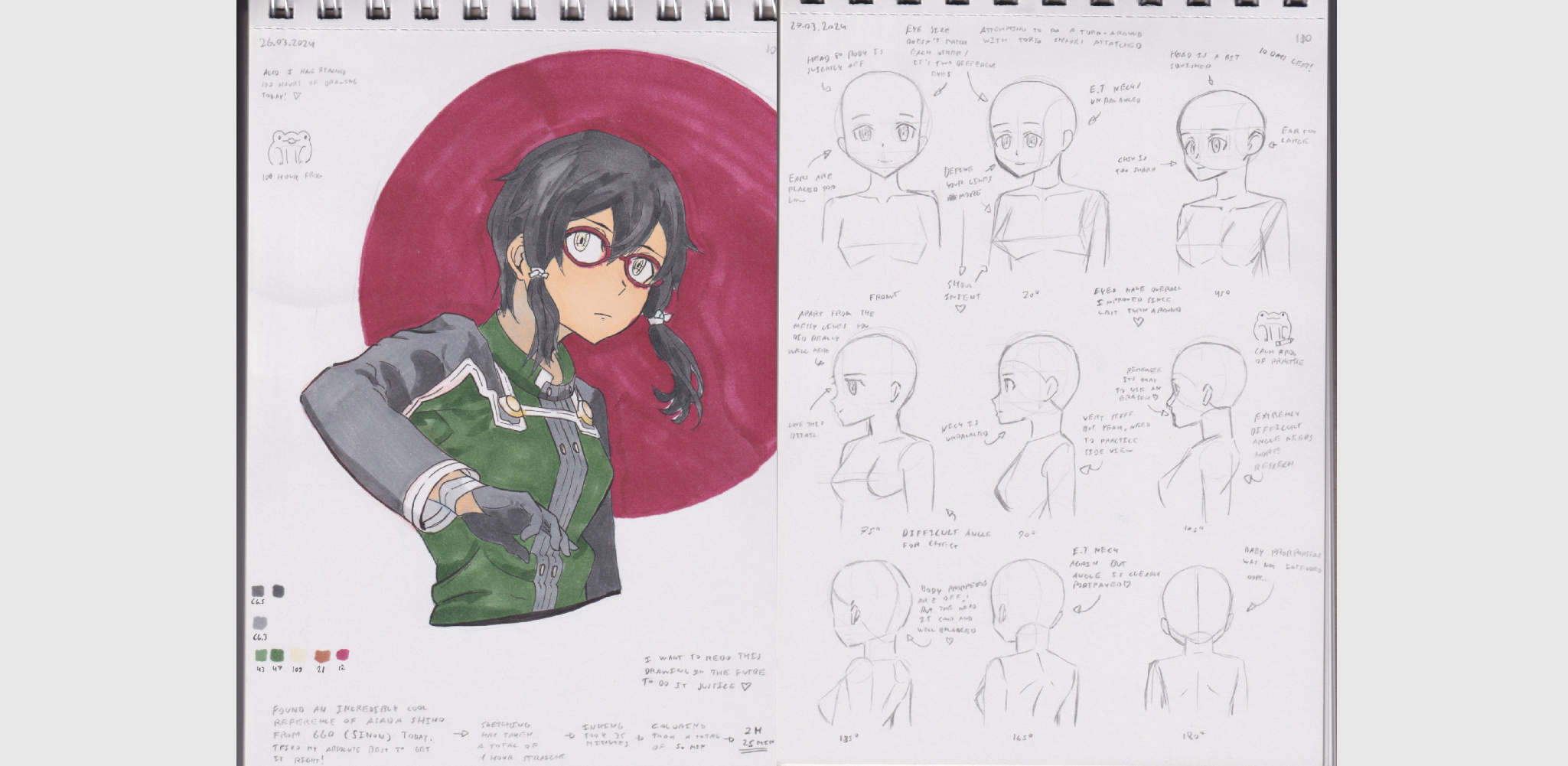
Today I learned just how bad the bleeding in the coloring I use is haha. I love the reference and will deftly have to redraw this same reference of Asada Shino from GGO (Have been rewatching GGO). The day after drawing Asada, I thought it would be fun to try and do a turn-around with the head and the torso.
Part. 4 – Clothing
Adding color and trying to match up the torso with head
Day 111-113
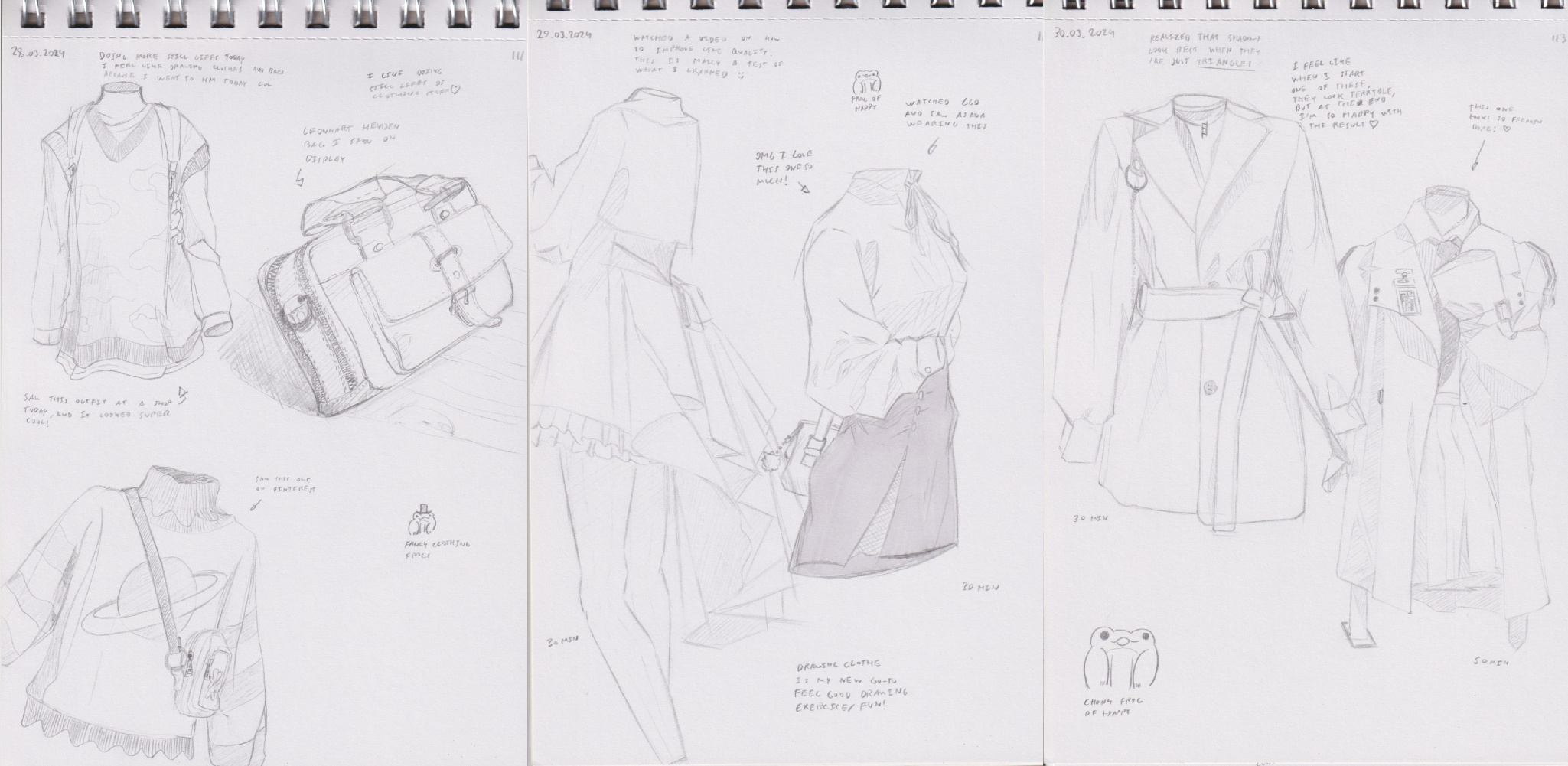
Today I went outside to do some clothe-shopping, and realized that I am quite fascinated by clothing, so day. 111 I did some still-life drawing of some stuff that was on display, and then on day 112 I learned something quite amazing!
So, line-quality. I think its about time that I point out that my line quality is really bad to put it kindly. I have a tendency to do short scratchy lines, and I am still not very confident in my lines when I draw faces, so will have to work on that. But I managed to improve my line-quality here on day 112, because I finally decided to actually focus on making longer and more confident strokes, at a pace that is not too slow nor too fast, but at a pace that I personally feel comfortable with.
Line quality
– In terms of improving line quality, the main areas of focus is to firstly try and avoid the two most common mistakes: short scratchy lines (also called 'chicken scratching'), and chaotic searching lines, that don't give a clear direction of about where the actual intended line is supposed to be.
– Speed is also very important for line quality, as going too fast will be imprecise and hard to control, while going too slow will give a wobbly and insecure look to the lines. Instead, try and find a speed in-between too fast and too slow, that you personally find to be comfortable with.
– Follow through with your lines, which means that its okay to have your lines extend a bit further out from where they were supposed to end. A good way of practicing this is also to combine it with ghosting the strokes before you do the final stroke. Ghosting the stroke means that you do the motion of the line you want to make, while holding the pen just a bit above the paper, and then lightly lowering the pencil to just barely touch the paper, while retaining the same stroking motion.
– Anything we draw can also be condensed down to 3 main kind of lines: S-curves, C-curves and straight curves. If we divide up complicated stuff such as muscles or clothing into just using these three kind of lines, and doing the entire thing in portions, this can help make the overall line quality improve, as one is no longer doing the entire outline in one single stroke.
Triangle shadows
I'm a little unsure about this one, but it helped me so much to discover on day 112 and 113 that I wanted to include it!
– When doing shadows, make sure that the shadows always form a triangle. You can bend and stretch the triangle as much as you'd like, but it seems to be giving much nicer results when the shadows always form a kind of triangle – especially when drawing the folds and shadows on clothing.
Day 114-116
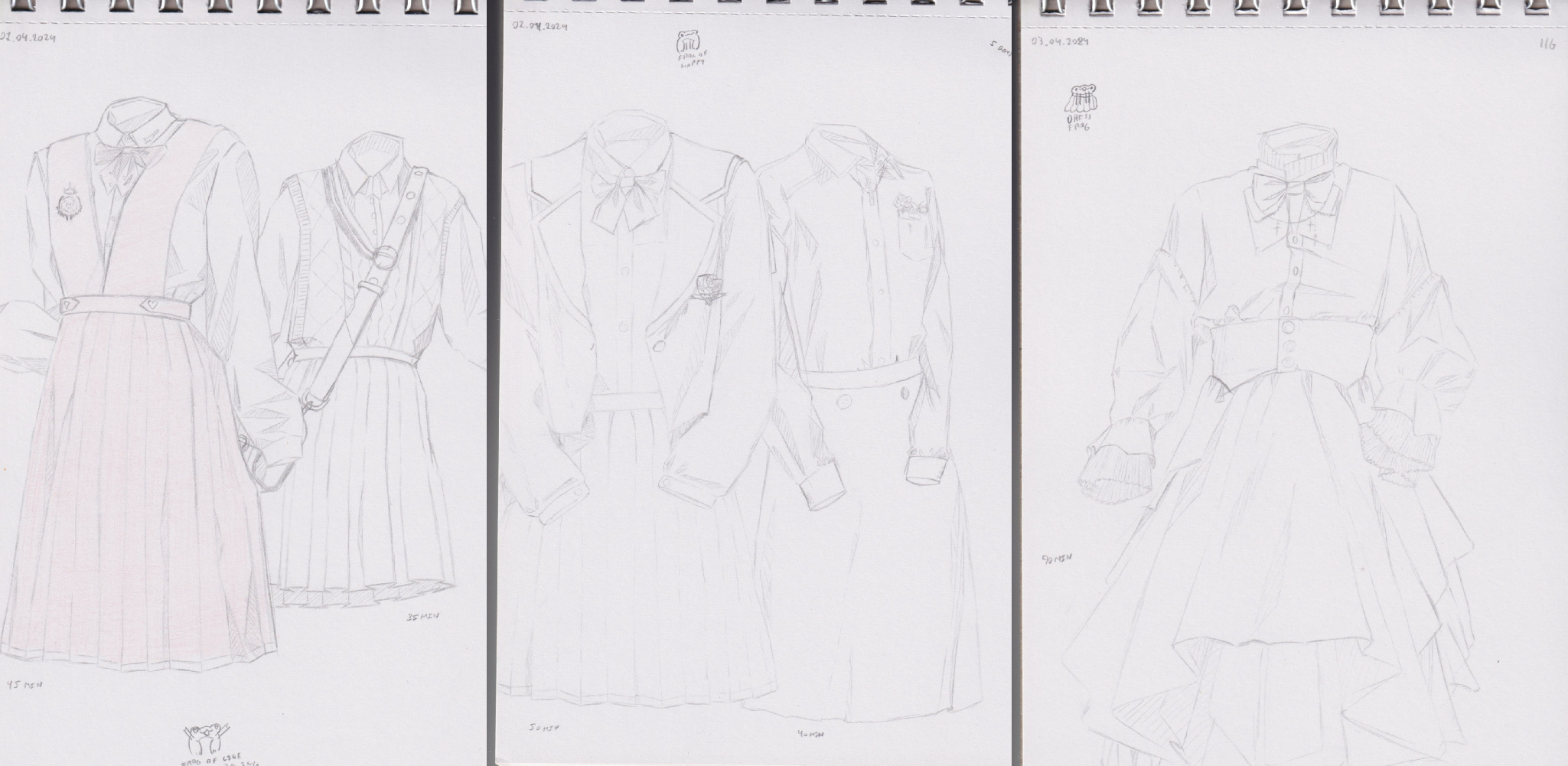
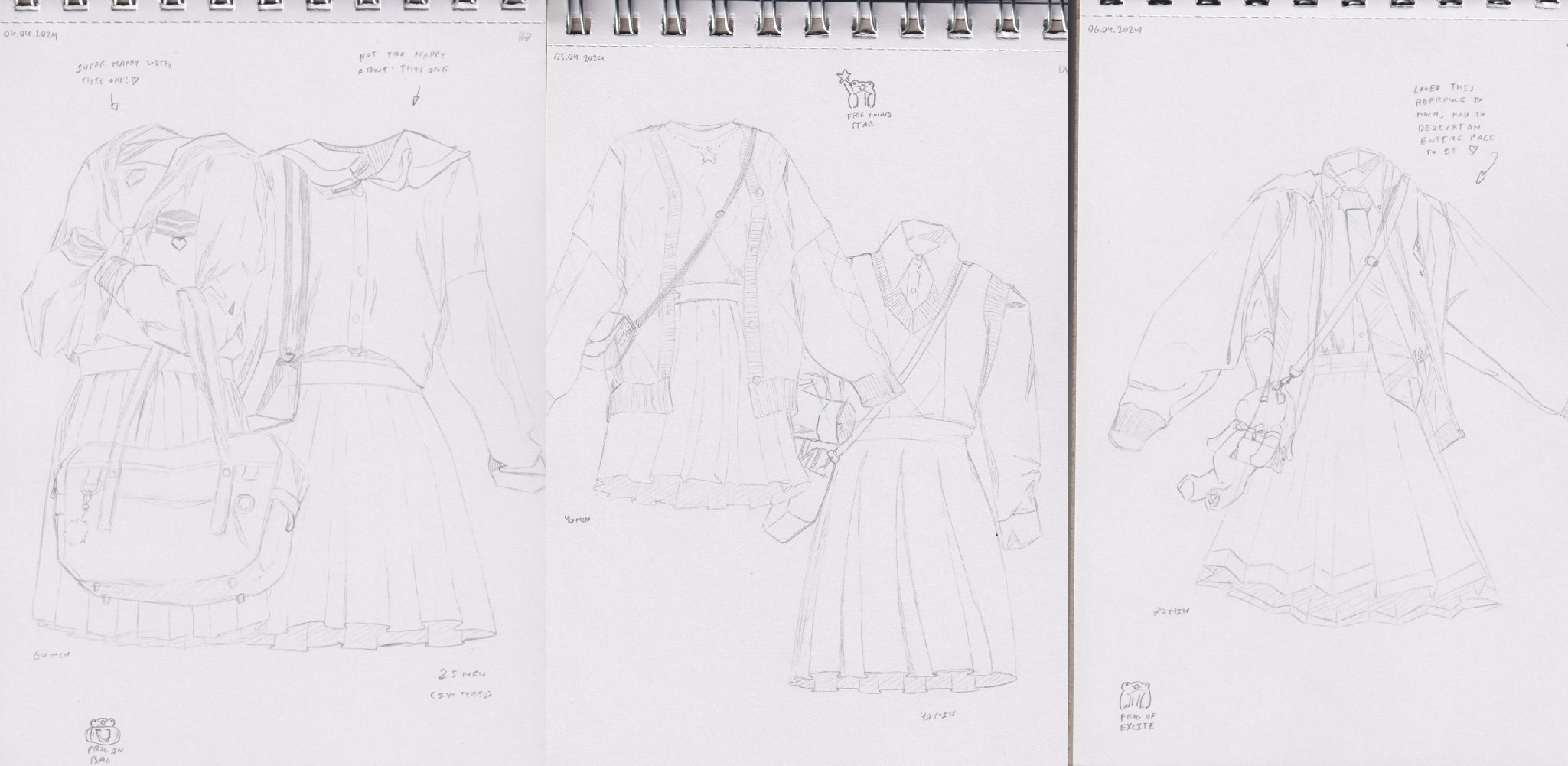
I spent most of my time doing clothes because I find it to be really fun to draw, and the results usually end up pretty good (partially because with cloths there is more room for proportinal errors compared to faces, since the human brain has a harder time accepting a face that is slightly off, than clothing that looks slightly off).
I also do these drawings to try and improve my overall line quality, and I will say, that I really feel like it has been helping to draw clothes with a main focus on the overall line-quality, instead of having my main focus on being proportionally correct. It's also nice to be able to just sit down, and do still-lifes for a change.
Day 117-119
Doing more clothing today, both to try and improve my line-quality and line-confidence, but tbh, I am using this whole drawing clothes, as an excuse to just kind of draw what I want to for the time being haha. Been following the study-plan and while it certainly works well... I am so tired
Day 120
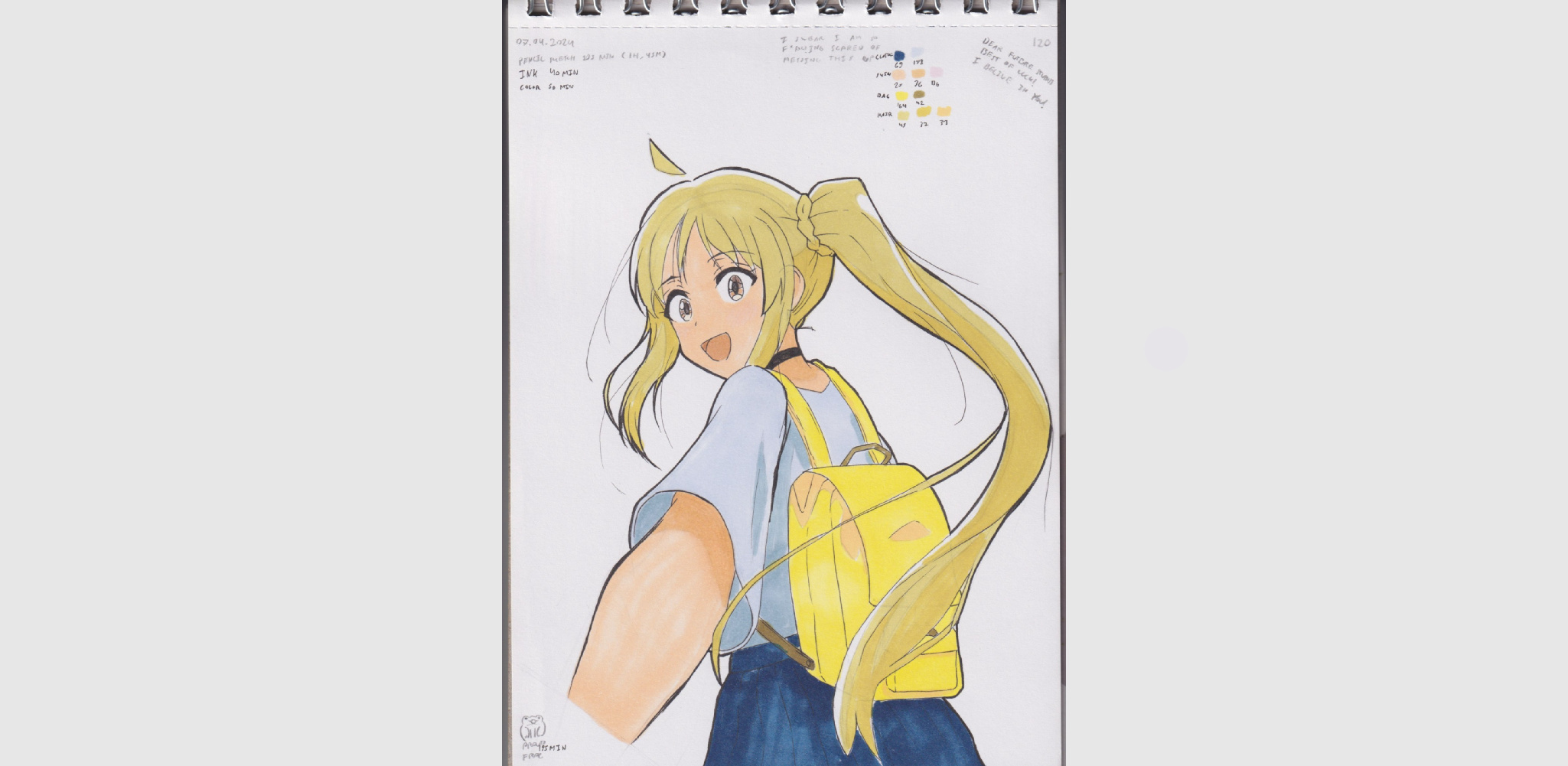
Today is day 120, and I am scared out of my mind because my fear of failure is kicking in hard. I haven't been practicing heads or faces for a while now because my mood has been so just... blergh! But looking at how it turned out, I am super proud of myself! There certainly are a few things I can still improve on, but I am mainly so proud of myself for getting the proportions and the line quality to be this good for the final drawing of Sketchbook Journey. II!
Looking at the final comparison, I can deftly see my own improvement in terms of proportions and overall line quality. While drawing clothes for a full week instead of doing the studies I was supposed to do, might've been a bit careless, I will say, it ended up paying off big time! Now I am even more excited to get started on Sketchbook Journey. III!
Thoughts that occurred while writing
My main takeaways from day 61-120
– Humans are creatures that get value from the time and effort they put into things, which especially seems to hold true when it comes to art. It doesn't necessarily mean that one has to spend more time and effort on a single drawing – it's more so in terms of putting time and effort into the practice and art-studies one does.
– Studying the skeleton and the muscles of the specific limb that you want to draw, is very helpful in an indirect way. What I mean by "indirect" is that by building up knowledge about the skeleton and muscle-groups, we slowly begin to intuitively make corrections, because we know that there is supposed to be a bone or a muscle in that specific place.
– Using myself as an example: When I started my torso studies, I had already studied the skeleton of the torso, and therefore I no longer really draw much of the actual ribcage or hip, because to me, they are just there. The skeleton has so-to-speak been "imprinted" into my brain, so that I just know where the ribcage and hip would be, without having to draw them. The same thing have slowly started happening with the muscles.
– Before the muscle studies, I had a tendency to forgot the trapezius (the big muscle that holds up our neck) in my drawings, but after having done the muscle studies, I've begun to spot whenever the trapezius feels "missing", and then adding it – sometimes without even spotting that it was missing.
– Two of the most important things when drawing fan-art of a character is 1: Proportions, and 2. The eyes. When you've made a fan-art drawing of a character, but your drawing just, for some reason, doesn't look like set character, almost all of the time you can point to it being a matter of either proportions or the eyes being off.
– When drawing characters from anime, I have started using a website called Settei Dreams, which has a lot of reference-material that was used in the actual production of a lot of popular anime. A lot of shows usually have proportion-guides, or shape-guides for the body and face of the characters, which I find super helpful when drawing fan-art.
– To help improve motivation, especially if you already have- og is currently creating a drawing that you think just looks terrible and makes you want to quit – look at what you don't like about the drawing, and be specific, than ask "Why can't I draw (insert), Yet!". Always add the "yet" to the end of the "why can't I draw (insert)" sentence.
– In addition to this, I really like the saying "Make your 100-hours of mistakes", as a reminder that it takes time, and that with learning to draw, we must equally practice the patience we have for ourselves, and our current capabilities.
– We don't draw from imagination, we draw from memory.
– Don't ruin or throw away your bad drawings, they serve as future proof of your effort and improvement, and even serve as a much better guide on what you need to practice more, compared to any of your best artwork.
– I myself mostly want to cross out or rip out the sketches from day 87. I cannot stand looking at how awful they are, but! If it was not for those horrendous drawings, I would not have discovered Loomis method, or been able to create my two favorite drawings on day 91, which used the Loomis method I discovered because of my bad drawings from day 87.
– The more you draw, the better you get – practice just sitting down and drawing every day, for however long fits your lifestyle. As little as 5-10 minutes every day is more than enough to improve.
– I have implicitly been referring to this throughout Sketchbook Journey. II, but the main factor that seems to differentiate when a drawing is good or not so good, is balance. Balance is referring to for example the issues on day 62 with the face looking swollen, and on day 87 where the colored character has an unbalanced "E.T" neck. A question of balance!
– Establishing a drawing routine doesn't necessitate a major overhaul; it's about integrating practice into existing habits. Identify your natural gravitation points, be it a desk or a cozy corner, and repurpose a simple container to store essential art supplies. Keep them within arm's reach in these familiar spaces, subtly beckoning you to pick up a pencil at a moment's notice. The goal is to make the act of drawing more accessible than reaching for your phone, weaving drawing into your daily rhythm.
– I placed a small metal flower pot at my daily study desk with my essential art-supplies, making access and tidying art supplies quick and easy. I also store my sketchbooks in open countertop below my study desk providing me acces to what I need without leaving my chair.
Future goals
Investing in a drawing software and tablet:
I still do not feel comfortable with the idea of moving away from traditional drawing, however, I have been discussing and researching a bit about "art"-software / programs and drawing tablets, and it turns out that I might actually need a more powerful computer, as (to my knowledge) my old macbook air that I use for everything, is not powerful enough to have a 500€ drawing tablet (which is what I am saving up for) attached to it with an equally heavy drawing software...
In other words: I will have to do more research on the subject, but it still a goal to one day, move over to digital drawing!
Commissions and paid work / T-shirt designs:
It will be most likely be another 1.5-2 years before I can make this a reality, but I would love to work as a freelance artist that take commissions and has a Patreon where I share in-depth video tutorials on specific things, as well as offer 'cheat-sheets' or 'measurement-sheets'.
Another thing that I may connect to Patreon (or maybe it should be a separate website) is creating t-shirt prints! Obviously these would be exclusive prints, as I have noticed that sites like RedBubble blatantly just steal artists work, put them on t-shirts and profits without giving anything to the creator they stole from.
Making art part- or full-time:
This is going to be my absolute longest goal, but since my studies will be coming to an end in 2 years time, that means that my studies will be ending around the same time as when I would most likely feel comfortable start charging a price for my art and start offering paid commissions, Patreon exclusives etc.
One of course never knows which direction life may or may not take, but I will ensure that I at minimum will be able to make art as a part-time job when my studies come to an end!
1000 hours of drawing, within 1 year
Turns out that if from now on, and till the new year arrives, I draw for 2 hours and 30 minutes every single day, I will be able to reach 1000 hours of drawing, within 2024. Have I gone insane and thrown all my marbles and common sense to the wind? Yes, partly at least :)
Is this a realistic goal for a university student studying 6 hours a day and having a part-time job on the side? My common sense is telling me no because I have to study for university and work part-time – but! I could quit my part-time job, live on the absolute bare minimum, have no money and basically be borderline homeless... But! What's the fun in life, if there isn't any risk involved? After all, while I may not be immortal, I am alone – a curse and a benefit that I am willing to abuse as long as I have it :'D